
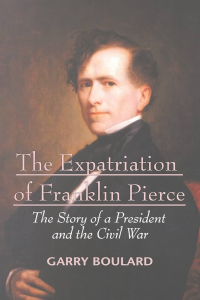
Continuing in the tragedy of Franklin Pierce, I chose to follow a short biography of him with this, a more focused look Pierce’s exit from the presidency, when he found himself wholly isolated. Four years ago, he had earned a record for most electoral votes gathered in any preceding election: he left office as the ‘leader’ of a party so split over slavery that it was soon to be ruined, hated by many. When the Civil War began, he was agonized: a lover of the Union, he nontheless believed the Republicans firmly in the wrong. Their continual attacks on Southern institutions that could not easily change, institutions that the South’s leading men were deeply invested in, had accelerate this crisis. He was also intimate friends with Jefferson and Varina Davis, and despite his preference for the Union could not in good conscience declare Davis a traitor the way so many who did not know the man did. A sympathetic letter to Davis would be intercepted and widely published in the North so that those who feast upon ‘the news’ and wax in self-righteous vitriol could declare him a traitor.
During the war, Pierce’s wife would die, as would one of his best friends Nathaniel Hawthorne — but such was the contempt northerners now held Pierce in that he was not even allowed to be a pallbearer at the funeral, relegated instead to sit and observe. As the war progressed, he would do more than sit: he would begin speaking out against Lincoln’s abuses of civil liberties, almost embracing the scorn levied on him by the war’s more ardent supporters. He did this at no small risk to himself, at a time when other men were being exiled or indeed even hung for the same ‘crime’. He had become a man without a country, loyal to a Union that had now transformed itself into something he no longer recognized. He was almost nearly friendless, too, removed from the Davises by the exigencies of war and then later prison. After the war, he would discreetly labor in behalf of Davis’ release from prison: fortunately for the former Southern president, the North had engaged in such an orgy of hangings after the murder of Lincoln that their appetite for blood was satiated and no one quite knew what to do with their stoic Mississippi prisoner. Tellingly, the Union government never formally tried Davis for treason, for fear that the case for secession might fare better in the courts of law than on the battlefield.
This was a winsome little book, giving Franklin Pierce a proper stage as a tragic figure. How complex a character he was, and his times — to stand for the principles of the Union, and in so doing, be accused of being a traitor to the Union. Pierce has proven quite the surprise; while he was perhaps not the man the hour demanded, in these biographies I have found him a man of conscience and compassion, dedicated to his friends and his principles and cheerfully willing to suffer slander in their cause. If I ever find myself up in New Hampshire I may have to pay my respects.
Quotations
Just weeks before the end of his term, upon learning that Varina Davis was ill and by herself with her new-born son at the Davis apartment on 14 and F streets, Pierce headed out by himself into a January blizzard with snow gusts waist-high to check on her. When a grateful Varina later asked why he had not simply sent a White House servant or two, Pierce remarked that “they would have no personal interest to urge them on.”
“I have no prejudice against the Southern people,” Lincoln declared, in one of his many nicely-composed phrases. “They are just what we would be in their situation. If slavery did not exist amongst them, they would not introduce it. If it did now exist amongst us, we should not instantly give it up.”
Alexander H. Stephens, foreseeing what he thought would by the cataclysmic results of a Lincoln victory [in May 1860], was much more certain: “In less than twelve months we shall be in the midst of a bloody war. What is to become of us then God only knows.”
Lincoln’s usurpation of power that was clearly not delegated to him by the constitution would have many ramifications: throughout the summer and fall of 1861 thousands of citizens, some guilty of nothing more than criticizing the president, were rounded up and thrown behind bars, usually charged with treason or sedition. They were writers, political activists, judges, and lawmakers.But in many other cases they were nothing more than simple American citizens.
In Washington, Chandler was regarded as something of a comical figure largely because everything he did had come to seem so predictable. This made him good for jokes that he did not appreciate. When Chandler dramatically declared he would join the Comanche Nation if the North permitted the South to secede, Texas Senator Louis T. Wigfall, unable to resist, responded “God forbid! I hope not. They [the Comanches] have already suffered much from their contact with the whites.” Everyone but Chandler laughed in response.
Yet despite his alarm over the course the country was taking under Lincoln, Pierce could never wean himself of a love for the United States itself. Polishing off a bottle of rum with Nathaniel Hawthorne in late January, Pierce remained convinced that the American experiment could still work: “He is bigoted to the Union,” Hawthorne said of Pierce, “and sees nothing but ruin without it.”
.
“I don’t quite understand what we are fighting for, or what definite result can be expected,” the author had confided to Horatio Bridge in May of 1861 as the towns of his native New England were awash in red, white, and blue bunting and endless military parades. “If we pummel the South ever so hard, they will love us none the better for it,” Hawthorne continued, before revealing that—unlike Pierce—he wasn’t all that excited about maintaining the Union in the first place. “And even if we subjugate
them [the South], our next stop should be to cut them adrift.”There could be no denying that Davis was deficient in political skills. Varina perhaps summed up the problem best when she said her husband “did not know the arts of the politician and would not practice them if understood.” Yet it was also true that Davis faced an almost impossible task as the commander in chief of a nation that had not even existed the month before he became president. Suddenly he was the head of a national government that had no existing or functioning bureaucracy, institutional memory, or executive precedents. And just to make his burden even more absurd, it was a government that was also at war with a far more powerful, rich, and populous opponent capable of recruiting more soldiers, producing far larger amounts of war materiel, and getting it to the front lines more efficiently on a vast network of rail lines.
In Lincoln’s wake something dark and forbidding swept over the country. At Fort Jefferson, Florida, soldiers turned on one of their own who said he was glad Lincoln had been shot and hung him. “I honestly confess that I have very little sympathy for him or any man who is not punished for similar expressions,” a fellow soldier remarked. Enraged crowds seeking to avenge the president’s murder ransacked the offices of the San Francisco Union and San Francisco American, both of which papers had been generally anti-administration. In Maryland, the editor of the Westminster Democrat was killed for unwisely running a column critical of the deceased president.
And now he stood on a wet night before a mob composed of boys old enough to know anger, but too young to understand much of anything else, and had to defend who he was.
But if critics thought Holt was too severe and unbending, it didn’t really matter. He only had to please one person, and that person was the president. And Lincoln was very happy with him, particularly after suspending the writ of habeas corpus and giving to Holt the responsibility—for the first time in U.S. history—of conducting military trials for civilian political prisoners. It was in this capacity that Holt oversaw the treason conviction of Pierce ally Clement Vallandigham as well as Indiana peace activist Lambdin P. Mulligan, who was sentenced to death; convictions that Lincoln himself reviewed and signed off on.
Then he added a sentence that could have, in the end, served as an epitaph for his entire career, but most certainly for his years as a lone voice of dissent in Lincoln’s America: “Some men are so constituted,” Pierce said, “that they do not incline to bow before a storm.”
“I can appreciate his ability, integrity and agreeable social qualities,” Sherman finally concluded of a man he rarely socialized with in the 1850s, adding: “and only regret that he was President of the United States at a time when the sagacity of a Jefferson, the determined courage of a Jackson, or the shrewdness and wisdom of a Lincoln were needed to meet the difficulties and dangers which he had to encounter.”

 Reading Freely