
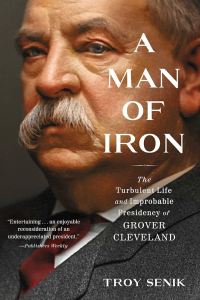
Grover Cleveland may have lost his claim to fame in being the only president to be elected to two nonconsecutive terms, but he is nevertheless a striking and memorable figure. Hailed as ‘the last Jeffersonian’ by another biography, his two terms in office spread across a sea change in Democratic politics: Jefferson’s party of constitutional reserve and deep skepticism of government intervention would be overtaken by populists who were willing and eager to go abroad in search of monsters to destroy. Cleveland, Troy Senik writes, is the only two-term president to have fallen into the memory hole, despite winning three popular votes in a row. Perhaps this is because his approach to governance was so unlike any that followed him – his commitment to principle over party….or popularity. Although in his second term Cleveland was slightly more willing to bow to that devil of political expediency, he was as H.L. Mencken described, a “man of iron” – one fixed on his values, popularity or success be hanged.
Cleveland is an extraordinary figure: the son of a struggling preacher who became a struggling teenager himself, forced by his father’s premature death to provide for his mother and siblings. He eventually found a place where he could study law while working, and developed a reputation for himself as a man of integrity . This is a rare commodity in politics, and it guided his career in politics from sheriff to mayor to governor to President in relatively short order. Cleveland is in fact the only president who has served all three of those executive offices, let alone serving them in such a consequential order. Cleveland’s reputation as a stiffnicked man of principle came in handy for the Democrats: they had been out of power since the Civil War, when the Democratic party divided into two geographical parts and the Republicans swept elections by default, leading to southern Democrats seceding from the Union until being forced back in by the bayonet and the bullet. Republicans had gotten soft after decades of power: they were corrupt and sore in need of a serious antagonist. That arrived in the mustachioed and rotund form of one Grover Cleveland, whose rise to power was so swift his first home was the Governor’s Mansion.
Cleveland established a reputation for himself in his lower offices as a man who was intolerant of corruption and immovable on principle: he often took actions that weakened his own party (like not filling positions with party-approved favorites, instead choosing the men most qualified), or annoyed his friends. He often chose an unpopular option in the name of principle, as when he vetoed a bill that would grant flooded farmers free seed. Cleveland was not a cold man: he gave generously to those in need, helping support a friend’s widow and child, but he saw no legal authority for disaster relief in Article 2 of the Constitution that concerned his office. That would eventually come to bite him in the end, once his unyielding views on monetary policy caused short-term economic issues that soured the entire country on the Democratic party, but it made his career and made him to be something of a legend. It’s harder for a modern reader to appreciate Cleveland’s policies, in part because the expected powers of the presidency have expanded so enormously – and in part because some policies are simply obscure to us. Monetary policy in general is an arcane subject, even to economists, but at the risk of making too sweeping a generalization – I have gotten the sense that the pure-gold standard was best for sound money, but made credit harder to access for poorer Americans, whereas including silver in the currency tended to risk inflation. We have not been on a gold standard since Nixon, and our constantly inflating prices testify to the fact – but back in Cleveland’s day, the amount of money in the banking system was fairly strictly tied to the amount of available gold to spend. It is an economic truism that there are no solutions, only tradeoffs, and part of Cleveland’s task as president was managing those tradeoffs. As a Jeffersonian, he was for low tariffs, because these kept prices lower for the working man, especially farmers and Westerners — but low tariffs also allowed gold to escape the country, as more specie flowed out buying foreign goods. The chapters on monetary policy will, in fact, be the hardest parts of this book to appreciate.
This is not a book about the policies of Cleveland, though: while they are considered at length, we also get a look at Cleveland the man. His contemporaries claimed he had “Cleveland luck”: Senik writes that if Cleveland were not a political genius, he had a remarkable ability to stumble into situations that made him out to look like one. He is intensely admirable, with a sterling work ethic and sense of moral order that reminds me of John Adams. Another contemporary remarked that the “Cleveland luck” was nothing more than obsessive work. Once G.C. was married, he relaxed a bit: it helped that his wife was younger than him, and so pretty that all of Washington was distracted by her. Senik occasionally comments on the personal scandals that Republicans tried to gin up about Cleveland, but sees no merit in them. Although I’d previously read a Cleveland biography, I found plenty of new information here: I didn’t realize how involved the plot to keep the public ignorant of his mouth-cancer was. He wound up being operated on in a boat, for privacy’s sake. This volume is also girthy enough to include Cleveland the man, not just Cleveland the politician, so we see him taking pleasure in fishing and hunting and being caught in reverie over sunsets and mountains and such.
I enjoyed Man of Iron enormously, and not just because of its subject whom I increasingly admire. Senik did a wonderful job of presenting Cleveland in the context of his times, and making him come alive. Although he’s very complimentary of his subject, Senik doesn’t shy away from him when that is merited – as he does during Cleveland’s second term. Senik sees Cleveland’s defense of an independent Hawaii as more posture than substance, since the expansionist Congress would overwhelm him anyway, and there’s similar criticism during the last gold-vs-silver debates. I took pleasure in reading that although Cleveland’s policies had caused disruption that caused the entire Democratic party to tank in his last election, he was nonetheless hailed ten years later as people recognized his unwillingness to bow before popular opinion, fortified as he was by the facts as he saw them.
[H. L.} Mencken, twenty-five years after the death of Grover Cleveland, opened a column about the former president this way: “We have had more brilliant Presidents than Cleveland, and one or two who were considerably more profound, but we have never had one, at least since Washington, whose fundamental character was solider [sic] and more admirable… [he] came into office his own man and he went without yielding any of that character for an instant.”
As Edward S. Bragg remarked during a nominating speech for Cleveland at the 1884 Democratic convention, “we love him for the enemies he has made.”
There is a long history in American life of bellicose men whose hardness was an essential part of their political appeal. Grover Cleveland, by contrast, was most easily roused to wrath when someone was misquoting Tennyson.
If the story of Mayor Cleveland’s inaugural message to the city council had to be summarized with one fact it would be this: it so outraged his adversaries that midway through its reading there was a motion to prevent the clerk from finishing it.
[Teddy] Roosevelt, whose rhetoric, when exercised, tended toward a curious mix of God of the Old Testament and petulant child, bellowed, “You must not veto those bills. You cannot! You shall not! I can’t have it and I won’t have it!” Cleveland had a trademark tic in moments like this. He would raise his meaty hand in the air. He would clench it into a cannonball. And he would land it swiftly back on the desk in a thunderclap. That sound and Cleveland’s simultaneous declaration—“Mr. Roosevelt, I am going to veto those bills!”—are recorded to have landed with such force that the young bull moose fell back in his chair… before subsequently excusing himself.
No one has endured more to make this project a reality than my wife, Veneta, who suffered through two years of her husband spending most of his free time with an obese, mustachioed nineteenth-century politician.

 Reading Freely