
The Rhine gives its gold to the sea.
But somewhere a glory awaits unseen.
Tomorrow belongs to me!
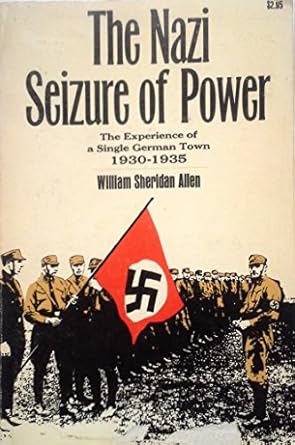
“Tomorrow Belongs to Me” is one of the more disturbing songs in the musical Cabaret, not because of the song itself, but because of what the viewer knows it portends. It begins simply, with one sweet voice singing at a country picnic; a young boy, not quite barefoot with cheek of tan but looking beatific all the same, until the camera pans down and reveals the swastika armband this Hitlerjunge is wearing. The lyrics gain menace as more and more citizens join him, at the end all singing lustily of blossoms and bees and somehow yet sounding like a people called to war. The Nazi Seizure of Power is a similar treatment, though at a more deliberate and academic pace. It is the story of a slow boil as the NSDAP struggled to find traction in this central German town, then all of a sudden appeared to be everywhere. The author begins by giving a profile of the town (its economic strata, health of civic organizations, and so on) before tracking the history of Nazism in Northeim until the fall of the Hitler state in 1945. Because of how intensely detailed it is in the first half — tracking Nazi activity everywhere from Lutheran councils to school boards — this might be a challenging read for a casual reader, but it has solid lessons to teach.
Allen’s opening profile of the town reveals how class-fixated it, and Germany, were. Every kind of social club was duplicated multiple times for different strata of society. This is relevant because the Nazis promised a society in which these divisions would be swept away in the creation of their “volksgemeinschaft“, the people’s community — and this was something people across parties did yearn for, although the socialist and national socialist ideas about achieving this were rather different. The profile also included an analysis of the political leanings of the town: the people were evenly split between ‘conservative’ parties and the social democrats, who were themselves fairly conservative in that they were the establishment. The SPD’s establishment status — committed to slow, gradual change — would prove to be a serious disadvantage when dealing with the Nazis once the Weimar economy faltered and Germans began radicalizing. When the global depression began, Germans lost faith in the “establishment”, or what Nazis called The System: fringe parties like the Communists and Nazis began growing in popularity, and notably both of these fringes were not dedicated to the preservation of democracy. The SPD proved an especially useful whipping-boy for the Nazis: Hitler’s cohorts could blame them for being both radical socialists and the bloated and entrenched establishment.
Although the book’s title declares this covers over a decade of Northheim’s history, that’s not really the case. 1933 to 1945 pass in the blink of an eye, with the author dismissing them as years of stasis for the Nazi party’s control. The book largely focuses on the late 1920s and the first two years of the 1930s, in which we see the Nazis boom from no-presence at all into a major force. This happens very quickly, too: in 1930, the Nazis barely had enough supporters to fill Northeim’s largest meeting hall a couple of times a year; by 1932, they were earning so much through membership fees that they kept the meeting hall booked on retainer, eating the fees so that it was always available to them and never to their rivals. One reason the Nazis succeeded in gaining interest was their focus on performance: their gatherings weren’t just speeches, but overall spectacles that included music, poetry readings, and more. They were also deeply invested in showmanship: even when their party numbers were small, not even able to sustain themselves at the local level, they focused efforts on flashy parades and fracases with other parties that caught attention. The Nazi takeover of Northeim is a classic case of “slowly, then all at once”: while for years their attention was on converting Lutheran church councils and local school boards, by the time Hitler came to power they had enough of a following to make the Nazification of all social institutions and society in general happen fairly quickly. The author notes that the Nazis, appreciating how their strength had been built through civic/social organizations over the years, denied that weapon to their enemies: the Nazi years were marked by the nazification of any social organization, even chess clubs. Those organizations that were resistant, like the churches, were overtly attacked and silenced. This, of course, is emblematic of fascism and totalitarianism: to quote Mussolini — “All within the state, nothing outside the state”. Burke’s ‘little platoons’ that constitute civil society were laid waste by the SA and later the SS.
The Nazi Seizure of Power was a detailed dive into how Nazis manipulated the social structures of Northeim to achieve power, and then destroyed those structures. It testifies to the role of theatrics and the economy into abetting Nazi power, and indicates how few people were really invested in the Nazi “platform”: what people longed for was Someone to Do Something, and the Nazi promise of wiping away class and social divisions. Antisemitism, interestingly, is not a large part of this picture: the author suggests that Northeim’s local intimacies made demonizing neighbors difficult, whether they were Jews or Socialists. That itself hints to how hatred was often ginned-up, rather than native. This was interesting but grim reading, and I am glad to be done with it.
T o the Socialists the Nazis were a threat only insofar as they might attempt an armed coup d’état. Serious politics was a matter of rational appeals and positive results. Since the NSDAP seemed incapable of either, they could not constitute a political threat.
But effective propaganda need not be logical as long as it foments suspicion, contempt, or hatred.
The SA generally incorporated weapons into their uniforms. Leather shoulder straps were made detachable and the buckles were weighted. Many SA men carried blackjacks, brass knuckles, or Stahlruten. These last were ingenious weapons consisting of a short length of pipe open at one end, inside of which was a spring with steel balls attached. The pipe was the handle; the spring and balls the weapon. When swung, the balls came out on the spring and struck with the leverage of their extended length, yet the whole contraption fitted neatly into a pocket.
When politics becomes a matter of vilification and innuendo, then eventually people feel repugnance for the whole process. It is the beginning of a yearning for a strong man who will rise above petty and partisan groups. The Nazis were to exploit this feeling fully, and though they contributed richly to the rise of partisan acrimony, they were also the first to pronounce “politician” with every possible tone of scorn and sarcasm.
The “German glance” (a sardonic play on the “German greeting,” which Nazi propaganda insisted was “Heil Hitler”) consisted of looking over one’s shoulder before saying anything that might mean trouble if overheard.
The single biggest factor in this process was the destruction of formal society in Northeim. What social cohesion there was in the town existed in the club life, and this was destroyed in the early months of Nazi rule.
Related:
Life and Death in the Third Reich, Peter Fritzschze

 Reading Freely
Glad you made it through this relatively unscathed. I dont think I could read something like this without repercussions in my real life.
I’ve been reading it slowly for over a month and taking LOTS of breaks for other stuff.
“The Nazi Seizure of Power was a detailed dive into how Nazis manipulated the social structures of Northeim to achieve power, and then destroyed those structures. It testifies to the role of theatrics and the economy into abetting Nazi power, and indicates how few people were really invested in the Nazi “platform”: what people longed for was Someone to Do Something, and the Nazi promise of wiping away class and social divisions”.
That sounds SO familiar for some reason… I just can’t place my finger on it…. [muses]