
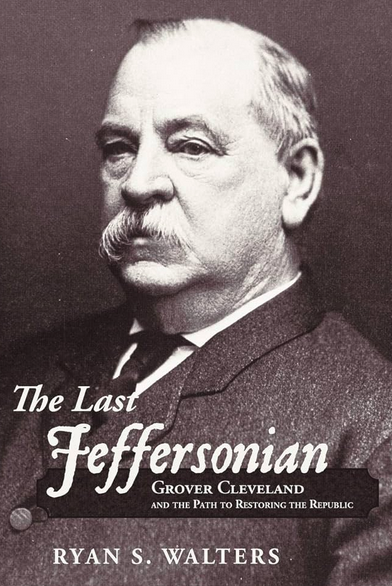
My political biography began during the War on Terror, when I developed strong feelings about foreign intervention and the military-police surveillance state. While reading Howard Zinn in my college years, I was astonished and delighted to learn of a US President standing up against corporate interests and thwarting their attempt to take over Hawaii in the name of the United States. Although his efforts were later rendered moot when another president bowed to imperialism, I still appreciated them. The man? Grover Cleveland. I’ve been wanting to read a proper biography of him for some time now, and when I stumbled on this in a used bookstore, I picked it up immediately. While it’s not quite what I was looking for – being more politically than biographically oriented – it did whet my appetite for reading more about the man.
The Last Jeffersonian introduces Cleveland as a man who was asked to step up to run for president in an hour when the Democratic party had lost its way. Castigated as the party of secession and rebellion, they’d been out of power for decades – but Cleveland, a man who had established a history for clean, fair governance both as a mayor and a governor, seemed to be the man to give them a fresh start. This introduction is important to the concept of the book, because the author is writing it in a day when the Republican party was rudderless as well: Obama had swept into power offering charisma and vision, and the best the GOP could offer was..er, Mitt Romney. Walters largely uses Cleveland’s legacy in office to critique other executives – chiefly Obama, given the looming election, but to lesser degrees the Roosevelts, McKinley, and FDR. Given that the book is not that large to begin with (~200 pages), this political sidequest may frustrate those looking for a pure biography.
When the book is focused on Cleveland, though, it’s quite interesting. Because it’s not a strict biography, Walters makes the choice to organize it by theme rather than chronology. There are chapters on Cleveland’s deportment, his domestic policy, his approach to finance and foreign policy, and so on. As mentioned, Cleveland had an interesting history as an executive: he began as the Mayor of Buffalo in 1881, graduated to Governor in the mid-1880s, and ended up President. His public slogan and private motto was that “A public office is a public trust”, and Walters argues that Cleveland lived up to this with zeal at each level. Coming from a family thick with preachers, Cleveland was a man convinced of the value of virtue, especially for those serving in public office. Because this is my first Cleveland biography, I have to take these claims with a grain of salt: these early chapters were nearly hagiographic. I was more interested in the chapters on monetary and foreign policy: here, facts largely tracked with what I knew, and I think Walters was successful in explaining the significance of the gold-vs-silver debates of the late 19th century in both public policy and the economy.
Walters describes Cleveland as Jeffersonian for good reason: he earned a reputation in both municipal and state politics for vetoing bills, whether to void unnecessary spending or prevent expansion of state power. This did not make him popular, especially when he denied a bill that would pay for seeds to assist farmers who had lost some of their stock: direct assistance was charity to be practiced by the people in themselves, not through the government. He appears to have largely honored the maxim, that government is best which governs least. There were exceptions, especially when it came to corporations: Cleveland was instrumental in creating the Interstate Commerce Commission to regulate the railroads, though the author notes the ICC quickly grew oppressive in its own right. Perhaps his finest moment, though, was trying to keep the Stars and Stripes free of the imperial stain and pushing back against the proposed annexation of Hawaii.
This was an interesting read: Walters is definitely writing for those strongly sympathetic of Jeffersonian ideals, and he draws on libertarians like Murray Rothbard and Ron Paul in his analysis of monetary policy. That’s particularly relevant for this political period given that it was the “Ron Paul Revolution”: Paul was building a huge following at the time, and connecting to the anti-tax, anti-spending elements of the older Republican base. As we know, that’s not the way the political winds blew: instead of getting a Jeffersonian, we’ve gotten a Jacksonian.

 Reading Freely