
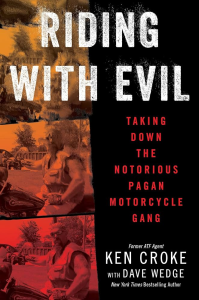
Ken Croke spent two years living a double life, one in which the ATF agent’s suburbanite existence was increasingly overshadowed by his second life as a sergeant in arms for the notorious PAGANS motorcycle club. The story unfolds in the late 2000s and early 2010s, twenty years after Billy Queen’s Under and Alone infiltration of the Mongols. The Pagans’ claim to fame was that they’d never been compromised by the law, and for good reason: despite their penchant for violence, they were good at organizational prudence. New prospects were deeply investigated, and would continue to be tested and probed long after they became members. To pass muster as a prospect and a patch, Ken needed to lose himself so much in the the role that he almost lost his life — both physically and socially, as it took time to repair his relationships with his wife and daughters after two years of increasing neglect. Riding with Evil is quite a look into the world of outlaw MCs, which manages to be more informative but somehow less compelling than Billy Queen’s Under and Alone.
Having read both Under and Alone and this, I must say: the Mongols sound a lot more fun than the Pagans. Part of this, I’m sure, is the way the memoirs are written: I strongly suspect Queen’s is more forthrightly delivered, as there’s a strong sense of “writing to the audience” here. Croke frequently alludes to worse to come, and there’s a lot of performative judging going on. Sometimes it’s comical: we witness through Croke these men being strung out on drugs for days on end, beating the hell out of their friends for trivial slights and abusing women, actively working on planting bombs to retaliate against the Hell’s Angels, moving bodies from one site to the other — and then Croke will write about how their being dismissive of women, or being racist, was a great motivation to him. His writing makes him come off as more naive than an ATF veteran could possibly be, as he writes in shock that the Pagans don’t allow blacks to become members. To my knowledge, the majority of criminal gangs are racial monoliths, especially in prison.
Anyhoo, back to the fun business: one reason Queen’s memoir was compelling was that he made genuine friendships with his brothers wearing the Mongol patch, closer bonds than he felt outside, and there was a genuine sense of betrayal when his case started bringing down guys he’d had good times with. Riding with Evil, though, is a two-year exercise in misery: in addition to the paranoia about being exposed as a fed, there’s paranoia about ordinary gang violence. The Pagans are always beating the hell out of each other, and not in fun “bonding” way: one prospect was murdered by a full patch right before Croke started hanging out, and toward the end of his time with the Pagans he witnessed several near-instances of murder within the ranks. It made me wonder why anyone would want to hang out with these guys: they even made motorcycles a drag, because forced runs would go on for far longer than any sane rider would go, and were made possible solely by the fact that everyone was hopped up on cocaine. Croke says he dropped riding for several years after this mission simply because the gang had killed the joy for him.
Despite this, there is quite a bit to take home from this. I was greatly amused by the fact that the Pagans were true-crime buffs, for both business and pleasure: they loved watching shows like Sons of Anarchy (though some 1%ers strongly disliked it) and crime TV, trying to record tactics the cops were using to bring down organizations like their own. They come off as incredibly savvy, especially in some of the tests they created: in one notable instance, Croke was forced to help some guys move a body, something they figured would expose any of the participants if they were informers. Surely the Feds wouldn’t let a dead body go un-investigated, a case grow cold? Croke indeed agonized over this: the shot drug dealer was somebody’s son, somebody’s father! Oh, the humanity! After the case was executed, though, years later, he discovered that the body bag was full of a mix of liquid and solid garbage. On the other hand, the Pagans allowed a relatively new member to handle their books because he was good with numbers, a fact that contributed enormously to their RICO takedown. (Croke’s background was in accounting before he got into law enforcement. Go figure.) There’s also a lot reveals about some stranger aspects of mob psychology: in addition to The Colors (gang vests) being treated as holy objects, the Pagans were also deeply superstitious about numbers. The Hells Angels used “81” as a number to refer to themselves, and Pagans therefore avoided saying 81, or places that incorporated 81 in their street addresses. Human psychology is deeply weird at times.
Although I had some issues with this book, it was quite entertaining: I thought criminal MCs had started declining in numbers since the 1990s, but apparently theirs is a booming business despite law enforcement’s expanding tools. The writing sometimes has that performative air, but there’s a lot revealed here. Definitely worth reading if you’re at all interested in outlaw MCs.
Related:
Under and Alone: the True Story of the Undercover Agent Who Infiltrated America’s Most Violent Outlaw Motorcycle Gang, William Queen
The Rebels: A Brotherhood of Outlaw Bikers, Daniel Wolf. This was an anthropological study of bikers, following a Canadian MC.
Biking and Brotherhood: My Journey, Dave Spurgeon

 Reading Freely