
608 pages
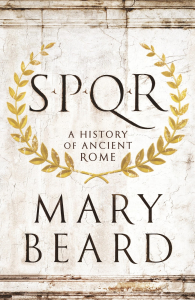
SPQR is an unusual history of Rome, one that largely ignores the imperial period to focus instead on ancient Rome — first, the early city-state, and then the expansive republic it grew into. It also ignores a general narrative, choosing instead to jump chronological periods and then comment on figures and topics relevant to that period. This leads to strange relationships between pagecount and subject: the Punic Wars get astonishingly short shrift while digressions on the meaning of the Romulus and Remus wolf-suckling myth goes on for page after page. As a fan of Tully, I liked that Beard often used Cicero’s confrontation with Catalina as a callback moment. For her, Cicero’s legal takedown of the would-be tyrant is an exercise in ambiguity: was Catalina a revolutionary, or a corrupt and broke aristocrat using the pain of the poor to create a base of power for himself? Beard sees the conventional narrative of Cicero defeating Catalina’s lawlessness as a story Rome wanted to believe about itself. Sometimes the questioning of traditional history can be interesting, but it often struck me as revisionism for revisionism’s sake. During the 1970s, for instance, it became popular to dismiss the claims of child sacrifice on the part of the Carthaginians as a lie created by the Romans — only it proved to be true. Yes, it’s true that stories about Catalina or his enabler Clodius Pulcher largely originate from their foes, but that doesn’t necessarily mean they weren’t morally rotten. I was willing to give Beard leeway until her comments regarding Marcus Aurelius, in which she refers to The Meditations as “cliched” and chastises Aurelius for severity against the Germans. I’m sorry that this man dealing with aggression from both Germany and Parthia at the same time as plague outbreaks, a treacherous co-emperor, and a cheating wife couldn’t , in his few moments of peace, write down reminders to himself that were completely sui generis! While there are many good points in the text, I definitely wouldn’t recommend it as a primer or survey: I think the novice reader would be lost given her many jumps, and the lack of a narrative to tie them together. I’ll probably read Beard again, if only to see if this is representative.

 Reading Freely
This is in my ‘Ancient History’ stack (or should I say ONE of them!). I’ll certainly get around to it at *some* point…… [grin]
I’m feeling a Roman wind blowing…..currently reading the Sicily/Italy in WW2 book, but I’m eying a history of the Byzantines, as well as a novel from Steven Saylor that continues the history of Rome through one family. (I’ve read Roma and Empire, but the next one is Dominus.)
I’ve fallen into a WW2 rabbit-hole (or should that be a fox-hole?) with books on D-Day and a deep dive into Winston Churchill…. Still a month or more away from my series of 10 20th century books – 1914-1983.
Ancient-wise…. I’d like to read outside the Greek-Roman world…. but Rome in particular has SUCH a pull!
I just watched PATTON last night, inspired by my current read of the Sicily/Italy invasion!
I remember it having its ‘moments’…. [grin]
Reading my present book I think I understand the North Africa campaign a lot better….
Which one are you working on?
I’m just about to finish ‘How Churchill Waged War’ by Allen Packwood. Its *high* level – about Churchill’s strategic & political decisions during the war. Its definitely a different view of things. I was aware of about 50% of it, but the perspective is definitely illuminating.
Interesting! May keep it in mind…