
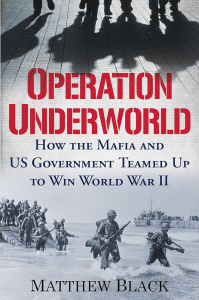
In New York harbor, one of the largest and fastest passenger ships ever built lies on its side, a victim of fire. French-built, the United States seized the Normandie after France fell to Hitler and renamed it the Lafayette, intending it as a troopship to help recover Europe from tyranny. Now, those plans were as defunct as the French defense in spring 1940. How could such a great ship flounder so quickly? Spies, perhaps? With German u-boats patrolling off the eastern seaboard, it wasn’t implausible that agents were snuck on shore – and it was even more plausible that German or Italian immigrants sympathetic to their home countries might aid and abet from inside America! The docks were obviously low-hanging fruit, and they were largely controlled by the Italian-American mafia – would it be possible for Navy intelligence to enlist their aid? It wasn’t as if Mussolini was a friend to the Mafia, after all: he’d persecuted their counterparts in Sicily vigorously. As it happened, the leader of the Syndicate in America, Charles Luciano, was in prison for his prostitution racket – and ready to make a deal. Operation Underworld is a mostly interesting if flawed history of both the mob’s role in helping the Navy secure the New York waterfront, and the Army in preparing for an invasion of Sicily. Its chief merit lies in that its subject is largely unexplored by anyone else, but it suffers from repetition, informality, and taking legends as fact.
When I’d run across Operation Underworld mentions in previous books, the information available was so slight as to leave the impression that Mafia soldiers themselves were actively working dock security for the Navy. The truth is a bit different: the Mafia effectively controlled the docks through control of the unions through which the docks operated, and the union leadership was only happy to help Navy Intelligence by creating Union memberships and jobs for government agents. This started off slow, at first, but allowed the g-men to create a network of patriotic fishermen and dockworkers who pledged to keep their eyes and ears open for anything hinky. One man did catch some German agents changing clothes on a beach, but ultimately the Navy deep-sixed their concern that German subs were being resupplied by parties in North America. Instead, the subs were being resupplied at sea by “milk cow” subs – though that doesn’t explain the presence of consumer goods sold only in the US aboard some German subs. Because many mafiosi like Luciano had contacts in Italy, they were also able to produce information that might be helpful to planning an invasion of Sicily and southern Italy.
As far as the unique content goes, it’s interesting enough — and I say that as someone who has interests in both the Mafia and WW2, so those who don’t may be less impressed. The author frequently revisits the backstory of Luciano, Lansky, etc, telling the story of their rise to power. This could be criticized as unnecessary bloat, but it did punctuate a stream of legal meetings and phone calls with occasional excitement like assassinations. Unfortunately, that adds its own problems: Black repeats legends like “The Night of the Sicilian Vespers” like they were facts. This, combined with his all-too-frequent and constantly repeated use of nicknames gives the book an unprofessional and sometimes sensationalistic air. Although I enjoyed this for its unique content, given how much of the text is accounts of meetings — meetings between lawyers and feds, meetings between lawyers and mafiosi, between mafiosi and mafiosi, etc — it took me longer than expected to get through.

 Reading Freely