
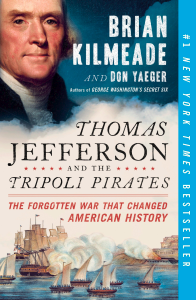
“From the halls of MONteZUUUUUUMA, to the shores of Tripoli” — ever wonder where that Tripoli business comes from? While I’d sometimes encountered references to the early United States having issues with pirates in the Med in its early history, it’s not a story I ever looked into. Recently, however, Gordon S. Wood’s Friends Divided mentioned Adams and Jefferson’s initial disagreement with how to handle the problem. What was the Tripoli problem? Four Islamist states along North Africa had developed a nasty habit of sallying forth, seizing ships and enslaving their crews or passengers under the mantra that all non-Muslims were fair game.While these states’ navies were not all that daunting, continental powers like England and France had larger problems that their navies were needed for (problems like France and England), so they simply paid off the looters. American ships had been covered under the Union Jack, but after Independence the Stars and Stripes represented a new target. At first, Jefferson tried to reason with the grand poobahs who controlled the pirates and work out a diplomatic solution, but founded they wanted an absurd amount of money. As other American officers would find out in the course of this history, they were also treacherous. The American government at tried to make a payment, only to be met with humiliation as the George Washington forced to carry tribute and slaves to the bloated royals of Constantinople. Soon the US Navy was dispatched in increasing numbers, and a great victory was won — only to be dashed by some diplomat oblivious to the military scene making a treaty under his own authority. Having seized a city with an exiled royal in tow — planning for some regime change — the Americans were forced to steal away in the middle of the night.
As with other Brian Kilmeade works, this is definitely pop history with a lot of flash: there is substance there, enough to prompt me to more serious reading, but it’s one I’d be careful about recommending except to those who already know to be cautious. Some reviewers on goodreads took issue with the “islamophobia” of Kilmeade’s approach, but Gordon Woods in his far more substantial Friends Divided also noted that Jefferson was prompted to use overwhelming force by the states’ “Islamic fatalism”. Given Islam’s perpetual problem with bloody borders I’m inclined to give Kilmeade the benefit of the doubt, but may follow this up with something like Lambert’s The Barbary Wars, which is more formal.
Coming up: Benjamin Franklin and the Swamp Fox.

 Reading Freely
This has been on my ‘Interest’ list for a while now…….. There’s a surprising amount of ‘forgotten’ History out there!
You might want to check this out too…
Bliven Putnam Naval Adventure
I have the hardcopy of the 1st book. The rest seem to be mostly Kindle only.
Sorry…! The author is James L Haley. [lol]
Having read serious accounts elsewhere, I have managed to avoid Kilmeade’s “pop history with a lot of flash.” I applaud his success with his growing list of books but will save my reading time for serious historians like Gordon Woods.
Having read about this issue elsewhere, I have chosen to avoid the “pop history with a lot of flash” of Kilmeade’s books. I prefer to spend my reading time with serious historians like Gordon Woods.
Agreed, but I wanted to pursue the interest while the iron was still hot!