
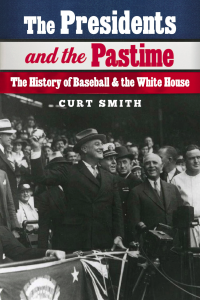
On October 30th, 2001, President George W. Bush threw out the ceremonial first pitch of Game 3 of the World Series at Yankee Stadium. It was a powerful moment, a symbolic step forward in recovering from the trauma of 9/11 only weeks before. American presidents have had a long history with baseball, and in The Presidents and the Pastime, Curt Smith tells a bit of that story while getting a little lost in the outfield. Although this book is in dire need of editing and organization — being a mix of biographical and presidential history that just happens to have baseball as a persistent element — for lovers of the game it’s a fun angle on the sport’s history.
While George Washington and John Adams played precursors of baseball, and Lincoln has connections – both mythic and otherwise – to the sport, Smith’s history proper begins with President Taft. Taft was an enormous fan of the game and initiated the tradition of presidents throwing out a ceremonial first pitch. From here, we move mostly forward with a lot of lateral meandering. Most presidents since Taft have been fans of the game, with the biggest exception being Teddy Roosevelt, and several have played the game themselves at the high school and collegiate level. Dwight Eisenhower even played semi-pro ball briefly under an assumed name, but this was kept hush-hush because he played collegiate ball for West Point after the fact, technically violating the Point’s rules governing their athletes. Richard Nixon and George W. Bush compete for baseball’s biggest booster: Nixon watched more in-person games in 1969 than LBJ managed in his entire presidency, and prior to becoming president he’d been offered the job of Major League Commissioner. Bush, in addition to having an ownership stake in the Texas Rangers, also considered becoming Commissioner at one point but followed his father’s path instead. Ronald Reagan had a unique relationship with the game, broadcasting baseball in the days when announcers were dependent on telegraphy updates to “recreate” the game: in one memorable instant, Reagan’s line went dark, and young Dutch had to ad-lib foul balls for the listening audience until service was restored. Some presidents followed Washington’s team, others like Obama clung to guns and religion their hometown favorites. (Once, while throwing a ceremonial first pitch at Nationals game, Obama concealed a White Sox cap in his glove and then popped it on upon taking the mound.) The book ends with Trump, but since it was published a year into his presidency, there’s not much to say – aside from the revelation that he was scouted by the Phillies and the Red Sox during his high school baseball days!
If this book consisted solely on the presidents and baseball, it would be perhaps a third of its length at best. Instead, biographies of the presidents, histories of political and global events, game play by plays, and team histories are all present here. It’s almost stream of consciousness sometimes, Smith frequently going off on side trails. Where might you guess a history of Ty Cobb and the 1910s Detroit Tigers might appear in a book on presidents and baseball? Try the chapter on Gerald Ford, where it’s joined by a discussion of historic Tiger Stadium and its loss to progress. A page devoted to Yogi Berra? In the opening section on George W. Bush. I didn’t notice this as much in Memories from the Microphone, and I think that owes to the fact that I experienced it as an audiobook, and being from the South I am accustomed to storytellers and preachers starting one story and delivering six more before they find their end to the first. Smith has that same peripatetic patter, but on the the page it’s more distracting – we jump through decades, there and back again, and sometimes one president will wander through another president’s chapter, and the same event is sometimes trotted out multiple times, like Perot’s role in the ’92 election. As far as politics goes, Smith was a speechwriter for “Poppy“, so he no doubt has his biases, but the narrative was more patriotic than anything else, the bright sides of each president being highlighted rather than their shortcomings. The book was great fun for me, but the narrative felt a bit like trying to ride a bull.
In short, this is an entertaining book to read, though it requires a reader who has solid interest in both presidents and baseball, not to mention patience. I enjoyed it, though, despite the frequent digressions — especially insasmuch as it revealed the presidents’ human sides. When one thinks of Nixon, the image is usually of dark, dour, troubled Nixon — not a man who has come alive, grinning like a little kid because the action on the diamond has just made him forget Vietnam, his political rivals, everything but the crack of the bat, the run, the fielding. The same goes for Clinton: I find it difficult to think plainly about the presidents of my childhood (HW Bush and Clinton), but the passage in which he derailed a professional broadcast by turning into a fanboy and screaming at the hitter to go, go, go, — drowning out the announcer’s mic — was hilarious. While this book definitely needed more editing/organization, it was still a delight.
Related:
Memories from the Microphone, the contents of which bleed over quite a bit here.
“I’m Jack Kennedy,” the forty-two-year-old told [Stan Musial], thirty-nine. “They tell me you’re too old to play baseball and I’m too young to be President, but maybe we’ll fool them.”
In another event, JFK hosted a dinner at 1600 Pennsylvania Avenue for distinguished Harvard alumni, most a generation or two older. “It is difficult to welcome you to the White House,” he told them, “Because at least two-thirds of you have attended more stag dinners here than I have.”
For those then alive, memory’s last act lies insight midnight’s muddle dried blood on Mrs. Kennedy’s suit, Lee Harvey Oswald, Jack Ruby, and the swearing-in on Air Force One of Lyndon Johnson with the widow at his side. Where were you in November 1963? Doubtless watching John salute at age three. The riderless steed. The caisson’s trek across the Potomac to Arlington Cemetery where JFK had told a friend, “I could stay here forever.”
In many towns, businesses literally closed when [Dizzy Dean] was ‘commertating’. To Ol’ Diz, a batter swang; a pitcher throwed; a runner slud. Fielders returned to their respectable positions. They had to be my words,’ Dean said, ’cause no one else would have `em.”
In 1991 Her Majesty Queen Elizabeth and Prince Philip visited President and Mrs. Bush at the White House. Out of office, Poppy was made an Honorary Knight Grand Cross of the Order of the Bath by Her Majesty at Buckingham Palace. Back in Texas, the former president asked Barbara, “How does it feel to be married to a real Knight?”
She said, “Sir George, make the coffee.”“And the Red Sox have won the American League pennant!” whooped radio voice Joe Castiglione, “their greatest victory in team history!”— the first “significant victory” over NewYork in 104 years. Without it, he noted, what “happened next didn’t happen”—to owner John Henry, “the biggest story in New England since the Revolutionary War.” Not wishing to contradict, Castiglione smiled. “I think he understated.”

 Reading Freely