
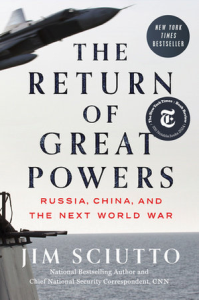
As mentioned yesterday I’m feeling burnt out between all the serious stuff I’ve been binging, global affairs, and ongoing drama with my computer (it was finally repaired and sent back from the manufacturer, but arrived in such a state that I had to take it to a local shop to be re-repaired), and really can’t get into review mode at the moment. However, I’m doing well on my goal of not leaving any books unreviewed this year and want that to continue, so here goes.
In The Return of Great Powers, CNN reporter Jim Sciutto reviews the outbreak of the Ukrainian war and the prospects of a Chinese invasion of Taiwan. These are not as unrelated as a casual reader might suppose, as both Russia and China have been growing in confidence and assertiveness in the last fifteen years, increasingly willing to test the rules of the international order in pursuit of their own national interests. Here Sciutto covers the first two and a half years of the war in Ukraine, as well as developments on the Chinese side that indicate they’re maintaining high interest in taking Taiwan. Despite the fact that most war models show devastation on both sides with no actual conquest of Taiwan, China continues to design its war machine around neutralizing American advantages. Unlike Ukraine, writes Sciutto, there is more than American honor and lives at stake with defending Taiwan, which plays a vital role in the manufacturer of silicon chips and other important components Of the Ukraine war, Sciutto remarks that it’s an interesting mix of 21st century tech and early 20th century attrition. Most of the text is Sciutto interviewing officials and working their remarks into a general narrative, and he follows the same general line of thought (or non-thought) that one gets from the media at large, like confusing non-interventionism with isolationism. One unintentionally funny line was Zelensky, in late January 2022, huffily responding to the Biden administration and telling them that he lived in Ukraine and knew more of what was going on after they warned about sustained and rising Russian militarization.
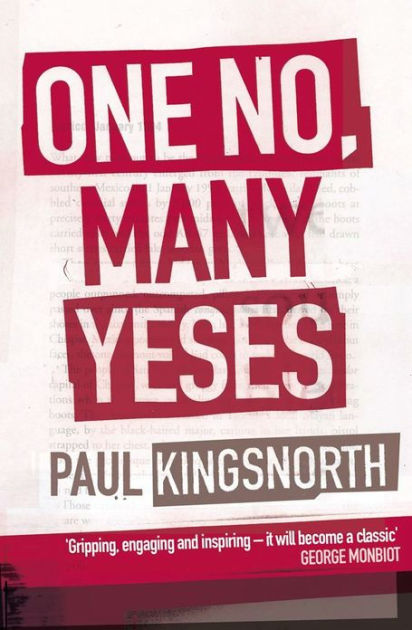
One No, Many Yeses is a much different work, featuring a much different Paul Kingsnorth than I’m used to. While the Kingsnorth I read is mystical and more interested in compost than politics, this Kingsnorth is twenty years younger and still in set-the-world-on-fire mode. The book chronicles his global journeys tracking the “Global Resistance Movement”, which is not as unified as its name suggests; it is instead a blanket label thrown over a host of similarly-inspired but distinct reactions to the disruption of local societies by globalization. These disruptions not only changed local culture and economies, to the detriment of those protesting, but changed the balance of power so that more power shifted from people in their everyday lives to politicians and financial potentates ruling over the masses, managing and moving them around in the name of their best welfare and the common good. Although Paul originally began hanging out with people like the zapatistas out of solidarity for their protests against the nature-devouring global hegemon, he admits later in the book that he discovered that the protesters’ deep local connections — the way they lived deep within a culture, were vital members of it, could not conceive of themselves outside a culture that was itself wedded to the land around them — was far more intoxicating. Although twenty years old, the ongoing rise of populism — now rising in long-developed countries — testifies to its enduring reference, especially the contempt for bureaucratic grandees in isolated power centers running roughshod over the lives of ordinary people.

 Reading Freely
Pingback: Short rounds: people and their places | Reading Freely