
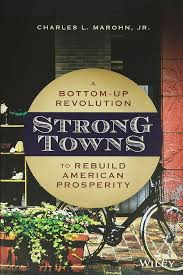
Years ago I heard an engineer being interviewed on a podcast about urbanism, castigating his fellow planners and engineers for supporting an approach to urbanism that was dishonest and financially ruinous. This engineer, Chuck Marohn, had recently started a blog to write about his concerns with his combined profession, and the implications those concerns had for the future of American towns. He wrote not just as an engineer and planner concerned about poor workmanship, but as a citizen and dad who was thinking about the world his daughters would live in. Nearly twenty years later, that dad with a blog is now the head of Strong Towns, a nonprofit organization that advises government officials and citizens alike on how urbanism goes wrong and what rational responses we can undertake to build more fiscally sustainable urban places. Strong Towns, the book, takes some of the core pieces of the organization’s journal and consolidates them into a stronger, more cohesive argument: if Thoughts on Building Strong Towns was a college thesis, this is the book proper, and it’s a fitting introduction for understanding not only why post-WW2 American urbanism looks so different from anything that proceeded, but the financial problems that urbanism poses in the long term.
There are two key points in this book worth noting: first, the departure from incremental and organic urban growth to more prescriptive and speculative “build it and they will come” growth; and second, what Chuck calls the “Suburban Ponzi Scheme”. Chuck frequently opens his lectures to city councils and groups by giving a history of his hometown, Brainerd – not because Brainerd is something special in urbanism, but because its story is that of most: it began simply, with people creating rough shacks along a trail. As economic activity increased, so too did investment in the city form itself: shacks were replaced by sturdier wooden structures, and then by still sturdier and ornamented brick buildings. City services developed as the growing tax base permitted them. Economic growth and urban growth proceeded together, hand in hand. After World War 2, though, planners being creating huge developments, and building them to a finished form – putting the cart before the horse, in a sense, and gambling that future growth would pay the bills. Sight problem, though: the new auto-oriented developments were fantastically less productive per acre than traditional urbanism – so much so that by the time they generated tax income to pay for their infrastructure, like roads and water pipes, the roads and water pipes would have already gone past their lifecycle and needed replacing. Many places have been able to push the bill down the road by financing yet still more developments, and using the money invested there to service hold debt – a bit like a ponzi scheme in which new marks’ money are paying off the marks further up the pyramid. This has become the norm, and it’s very much enabled by the federal government, which offers grants to help build infrastructure to facilitate “growth” – nevermind that maintaining infrastructure can be financially ruinous.
Ultimately, Chuck advises that cities get real about the maintenance backlog and admit that some things can’t be sustained: cities will contract, purely out of triage: it’s that, or go bankrupt, as Detroit did and as Jefferson County, Alabama did. Detroit, he warns, is not an exception: it is the harbringer. Detroit threw itself into auto orientation earlier than most American cities, and its bills came due earlier as a consequence. For those who are interested in learning more, StrongTowns abounds in articles on both the problem and rational responses. I can’t pretend to offer an objective review of the work given my fondess for the author and the fact that I’ve been reading Strong Towns’ articles for at least fifteen years. Strong Towns takes some of its best observations and integrates them together, to good effect in my (biased) opinion. I will note that the audiobook is not read by Chuck, which is a disappointment. Chuck has a very pleasant speaking voice, so much so that I’ve actually dropped in on zoom calls where he was briefing a city council.
Related:
Confessions of a Recovering Engineer: Transportation for Strong Towns, Chuck Marohn
The Geography of Nowhere, Jim Kunstler
Suburban Nation: The Rise of Sprawl, Andres Duany, Elizabeth Plater-Zyberk, & Jeff Speck

 Reading Freely