
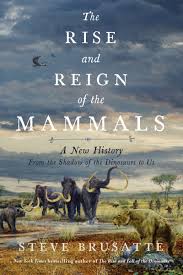
Mammals, we learn in elementary school, are warm-blooded critters who give birth to live young, produce milk, and are noted for their hair. Only….as we get older, we learn about marsupials and platypuses and whales and realize the story of mammals is a little more complicated than those easy descriptions and bold strokes. The Rise and Reign of the Mammals is a natural history of the best class of the Animal Kingdom, one that begins long before the dinosaurs and continues unto the present age. Densely detailed, it begins with a surprise and begins wrapping up with the fall of the mega-mammals like Irish elk and giant ground sloths.
The beginning of mammals, interesting, lies not in fur or even the milk that gives mammals our name, but with a slight change in jaw structure, one that led to those teeny-tiny bones in our ears. This is where the story begins, in creatures that are much larger than the little mice hiding from dinosaurs that are typically the beginning of the mammal origin story. As we move through vast spans of natural history, the elements that make mammal-kind are picked up piecemeal, Brusatte documenting where they first appeared and musing as to why. Dinosaurs are emerging at the same time, of course, and the author offers an interesting perspective: yes, dinosaur predation probably drove mammals to become smaller and smaller, but mammals were so good at below-the-belt life that we prevented dinosaurs from growing smaller and filling those niches. Brusatte notes several things about mammals that allowed us to flourish after the mass-extinction impact that did the dinosaurs in: we were adaptive, aggressive, and fecund. From little vole-like creatures skittering about on gloomy jungle floors came bats, a staggering variety of land animals, and whales, flooding every ecological niche in a furry blitzkrieg.
The book got really interesting for me as it drew nearer us, more for the species who were around when humanity was covering the globe despite much of the northern hemisphere being covered in glaciers. I love reading about the old megafauna, and they get a solid treatment here: I didn’t realize the first of their bones was discovered on the South Carolina coast, by slaves who discovered when while digging and realized they were looking at something like elephant molars. (Speaking of, this book corrected me on something: I always associated mammoths with woolly mammoths, but Columbian mammoths who didn’t have the shag-carpet fur had a much larger range.) The book ends, of course, with little ol’ Homo Sapiens and our now-vanquished kin, everyone from the Neanderthals to the Indonesian hobbits. Our impact on the Earth is massive, of course, but the author isn’t all-in on the theory that we destroyed all of the megafauna in some murder-happy rage: instead, our aggressive and skillful predation probably pushed species that were being stressed by climatic shifts over the brink.
Rise and Reign is a substantial and fascinating history: well-written and adequately illustrated. Some of our foregoing cousins are delightfully bizarre to consider, and I appreciated the author’s care in not going too far off on any speculative limbs.
Related:
Twilight of the Mammoths, Paul S. Martin

 Reading Freely

Evolution is *endlessly* fascinating. This sounds like a good read…! We’d probably still be rat sized and living around dino houses & farms if a giant rock hadn’t of fallen from the sky 65 million years ago. Lucky us!!
It left me wishing that some other version of Homo had survived –on an island, somewhere. Oddly enough that’s not a premise that’s been explored in much alt-history or SF that I can find.
Nothing of that sort of thing rings a bell with me either…