
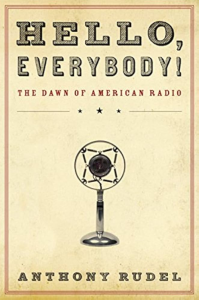
The late 19th and early 20th centuries saw a host of technologies released that utterly transformed society, and few as dramatic as radio. Hello, Everybody! is an engaging history of the early decades of radio, filled with some dramatic, unbelievable characters. Anthony Rudel baits the hook early, with the bizarre rise of one John Brinkley — a quack who used his folksy charm and private radio transmitter to build an empire from goat testicles and patent medicines, a man who was so popular he ran for governor twice on write-ins and very nearly won — before examining how radio shaped sports, politics, religion, and news. It’s a solid piece of popular history, the kind that is not only genuinely informative but entertaining enough that the reader is likely to annoy friends for weeks afterward sharing especially juicy facts. Hey, did I tell you about the lady radiovangelist who faked her own death (and abduction by bandits) so she could have some smoochy time with a married man?
We begin with the development of radio from wireless telegraphy before quickly getting into the fun stuff. Readers who experienced the early computer age in the seventies and eighties may find themselves with a minor case of deja vu as we learn about radio taking off as a hobby for geeks and enthusiasists, building transmitters and receivers at home and broadcasting signals into the ether. Some, like a diploma-mill physician in Kansas, had the idea of getting some practical use out of their hobbies. “Dr.” John Brinkley enjoyed offering radio programming to his area, and then realized he could become the prototypical “teledoc”, reading letters on air and offering prescriptions — which always involved buying his patent medicines by mail. Early programming was all over the place, reminiscent of 1990s websites: one station might feature a man reading the headlines from the newspaper, and another had the idea of offering college-level lectures on air for those who wanted to improve their education. Herbert Hoover cuts a prominent figure in the book’s first half, as he was responsible for trying to create order out of the primordial chaos: places like New York, where there were many transmitters competing with one another, were especially messy. As things became a bit more orderly and the industry grew, politicians and religious figures found radio a powerful tool for sending for their message: one Catholic priest, disturbed by the paltry number of parishioners at his little church, had the idea of broadcasting the service and would grow to be a media giant, known as Father Coughlin, whose talks could reach an entire fifth of the American populace. The book has a lot of surprises: “Silent Cal” Coolidge was quite comfortable with using the radio, for instance, and some early sports authorities were positively resistant toward the new medium, believing that broadcasting matches would undermine ticket sales. The book ends with the rise of Franklin D. Roosevelt, who used radio masterfully to win and maintain the trust of the American people during the great depression.
I’ve been meaning to read this for a few years now, and chanced to see it available on Kindle Unlimited. It proved a thoroughly fun dive into the early 20th century, and stuck me as very similar to the internet revolution that I personally lived through: this look into the dawn of the mass communication age is also the dawn of our own information page. Definitely worth taking a look at!
Related:
The Network: The Battle for the Airwaves. This is more of a technical & government-policy history of radio broadcasting. Quite readable and useful, but not focused on culture the way Hello Everybody! is
The Victorian Internet, Tom Standage. On radio’s papa, telegraphy..
Empires of Light: Edison, Tesla, Westinghouse, and the Race to Electrify the World, Jill Jones. Again a history of patent wars and technical innovation, less attention on changing society.

 Reading Freely
Pingback: The Best of 2024 – Year in Review! | Reading Freely
Pingback: Memories from the Microphone | Reading Freely