
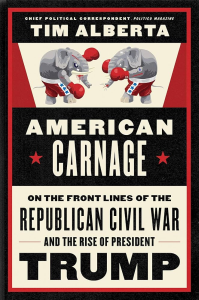
I fell out with both wings of the old uniparty in the mid-2000s over the war on terror and its attendant police state, which both parties supported despite some gum-flapping on the part of the Dems during the Bush years. Consequently, I wasn’t tuned in to what was happening with the GOP until Trump swept the Republican convention in 2016, knocking both establishment honchos like Jeb and the rising “Tea Party” champions like Cruz aside. American Carnage is an extremely detailed history of how the Republican party changed in recognition that its base was becoming more primed towards belligerent anti-state populism, rather than a defined ideological disposition like Reaganism. Although it’s written with a distinct animosity towards the populists, Carnage doesn’t demonize them. It recognizes that legitimate concerns and fears were fueling the animosity towards the establishment, principally the toll that NAFTA had taken on American industry and the communities it sustained. Given how fine-grained the reportage is here (meetings, interviews, meetings secret meetings, interviews, meetings), this is probably written more for wonks, but I enjoyed it all the same. I was particularly fascinated by Thomas Massie’s disappointed realization that voters were supporting liberty iconoclasts like himself, Amash, and Rand not necessarily out of libertarian principles, but because those voters wanted “the craziest SOB in the race” to attack the establishment. This is how the same populism that fueled the fiscal-conservative-oriented Tea Party could also fuel Trump: raging against the machine was more important than policy, and the new era of social media allowed populists to bypass gatekeeping media and gatekeeping party infrastructure that controlled funding. For readers already familiar, this book is also an interesting character study into Boehner and Ryan in their attempts to be responsible to the people and the party, while also having to deal with Trump’s unpredictability and the disruptive energy of the populists who were now not only pushing for increasingly challenging candidates, but sometimes taking office themselves. Unfortunately, this book doesn’t really address the sources of the populist energy– economics, the power elite’s increasingly transparent contempt for flyover country, etc — but just looks at how that energy disrupted the GOP. Fascinating stuff for wonks, I’m sure.
Palin’s resonance with Republican voters was, above all, an indictment of the party’s tone-deaf arrogance. Having catered to the aristocrat caste atop the GOP for decades, winning far more elections than they lost along the way, Republicans were blissfully ignorant of the discontent simmering below the surface. When it boiled over, the defensiveness of the elites—reproaching Palin, for example—only made things worse.
Boehner and McCarthy agreed to attend the Bakersfield Tea Party event on the condition that they not give any remarks. Boehner suspected with some justification that these crowds would be just as hostile to Republican politicians, especially leadership officials, as they were to Democrats. “We’re at this event, and there’s some people who are really happy that we showed up,” Boehner recalls. “But there were others that just looked at us with more disdain than you could ever imagine. They thought we were the enemy.”
He recalls wondering how, if Republicans took back the House, Boehner would handle a mob of rookie revolutionaries. When they met in Washington, shortly before Election Day, Boehner’s answer was simple: They would fall in line. Freshmen always fall in line. But the party chairman was not convinced. “These guys are out there blowing up Republicans as much as they’re blowing up Democrats,” Steele told Boehner. “You mean to tell me you can’t see that?”
As people watched their jobs disappearing, their communities hollowing out, and their national character changing, they wanted a brawler—not a bookkeeper.
[Cruz] had spent his teenage years touring the state of Texas delivering the Constitution from memory as part of a free-market troupe and had also been involved in drama club, briefly considering a career as a thespian. (On the Bush campaign, he was known to launch into various recitations of his favorite film, The Princess Bride, capturing every line and every character’s accent with precision.)
What Bush and his Republican peers failed to understand was the degree to which Putin had become an appealing figure for many on the American right—not for the particulars of his government’s cruelty, necessarily, but rather, for the masculinity he radiated in such sharp contrast to his U.S. counterpart.
Trump did not suffer from a lack of teachability; he simply preferred to dictate the flow of information, rather than be dictated to. Lengthy briefings and conference calls were never a staple of his executive style. He favored an aggressive, inquisitive approach, learning about issues, and about people, with rapid-fire questioning, consuming what he needed from the answers and discarding the rest.
“I was elected to represent the citizens of Pittsburgh, not Paris,” he decreed.
That summer, having breakfast with a blissfully retired Boehner, I asked him whether the Republican Party could survive Trumpism. “There is no Rep—” He stopped himself. There is no Republican Party? He shrugged. “There is. But what does it even mean? Donald Trump’s not a Republican. He’s not a Democrat. He’s a populist.”
“Twenty years ago, you and I might disagree strongly on politics, but we’re on the board of the same PTA, and our kids go to the same school, they play on the same sports teams, and we go to the same church on Sunday. I knew you as a whole person,” Rubio says. “Today, we increasingly know people only by their political views—or we just don’t know people unlike [us] at all.
A lot of people think Trump is a footnote, that he’s just here for four or eight years, and then it goes back to normal. But I think that’s wrong. I think the party is changed for good,” she says. “And it won’t be sustainable. We’re in a period of incredible change as a country where the extremes of the left and right are going to converge, and you’re going to wind up with a third party. Over the next two or four years? No. But in the next twenty? For sure.”

 Reading Freely
I *think* this is on my Wish List….. [muses]
Pingback: The Best of 2024 – Year in Review! | Reading Freely