
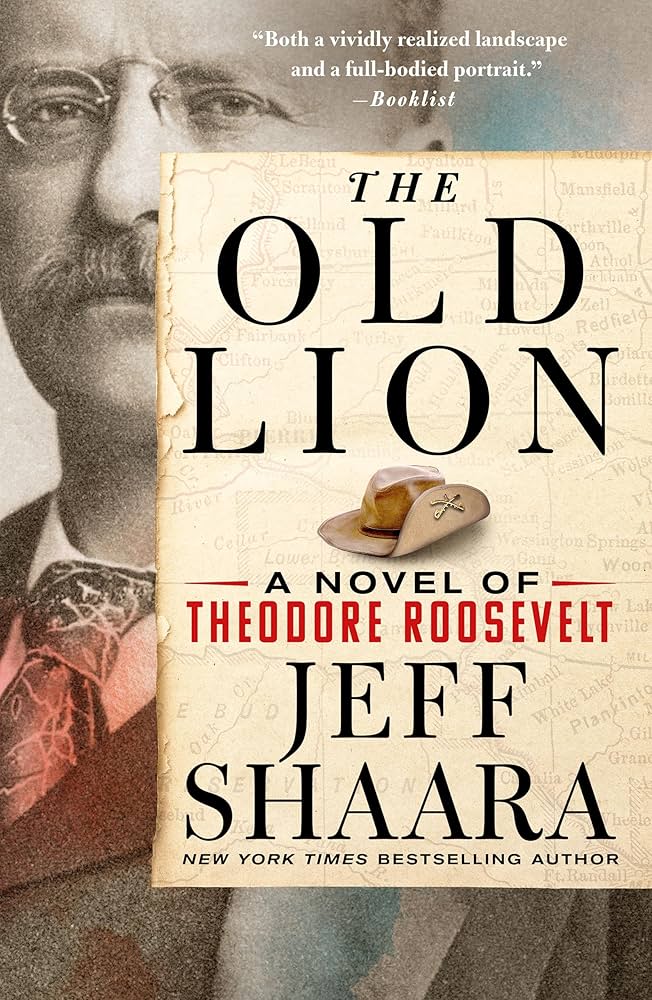
Imagine if someone wrote a fictional biography of Chuck Norris, but they used the internet legend version of Norris as their inspiration rather than the actor himself. That’s what impression The Old Lion gives me, frankly, a worshipful depiction of Teddy Roosevelt in which his only fault is loving his first wife too much and not being able to be there for her namesake daughter in her youth. Teddy is always, always, morally admirable. Born a weak child? By God, he shall lift weights and make himself better! He has absolutely no 19th century prejudices at all, he is a friend of all mankind — and to women, too, who only don’t have the vote because other men are afraid of them. Teddy isn’t, though, because he’s a lion — a hero, a legend. He has all the right opinions and he hates all the right people and he is not believable for one minute.
As a novel, this has its interests. There’s a lot of focus on Teddy in the West, and whereas I’d assumed Teddy had a rather passive role there, playing cowboy using his money while other men did the work, Shaara has Teddy playing the lead role in a 1950s western, complete with hauling dangerous criminals across the landscape all night so they can be given a fair trial instead of simply being hanged for being low-down no-good horse thieves. (Even the thieves asked him why he’s bothering to go through all this work, at which point he harrumphs about the importance of law and order in bringing civilization to the west.) We also see Teddyboy running around in the Spanish-American War (where he’s absolutely skeptical about the Maine but nontheless gung-ho about going to war to provide ‘leadership’ and inspire the other people of the Americas against European mischief). One segment of the Spanish war is especially interesting, as he has the idea of repurposing a giant kettle on a sugar plantation as cover against Gatlin guns. I didn’t realized how varied the man’s life was — he doesn’t get on a political train and follow it to the presidency, but goes back and forth between being a politician, cattleman, soldier, and so on. This offers constant change for the reader, but the more I progressed the less I cared about the story, simply because history was not being taken seriously: Roosevelt dismisses William Jennings Bryant as if he were Vermin Supreme rather than a man who became Secretary of State — and better yet, scoffs at Bryant’s reforms as ambitious nonsense when it was Teddyboy who had the megalomaniacal idea for using the government to force people in spelling English in some truncated manner that had caught his fancy. Things like this made me feel that Shaara was simply not invested in the zeitgeist he was writing about, because ignoring the draw of Bryant’s populism makes as much sense as ignoring say, the labor movement in that same time period.
Despite enjoying parts of this, its version of Teddy struck as too simplistic and worshipful, not plausible given the times he lived and worked in. Admittedly, I’ve never read a full biography of Roosevelt, but it strikes me as improbable a 19th century aristocrat would have the same views on native Americans, blacks, women, etc as a 1990s politician would. Shaara does season in some reality later in the book, when Roosevelt invites Booker T. Washington to the White House and Washington quotes some of the real TR’s racial remarks at him — remarks which seem disconnected from the race-blind Teddy of the early novel — only for Roosevelt to declare that men change. There are other details that show Shaara’s research — Teddy’s referring to Alice Jr consistently as “Baby Lee”, since her mother’s death traumatized him, and some of his verbal tics. As it happens, I more or less like Teddy, despite the fact that if I mention him on this blog it tend to be a critical observation: despite his influence on creating the imperial presidency, his own passion for expanding the empire of DC far beyond what the poor benighted Republic could bear, I find him generally admirable as a man. Spirited, disciplined, pugnacious, driven: even when he was shot he turned it into an opportunity to campaign, declaring that “You can’t stop a bull moose!”. He’s just too ‘lionized’ in this novel for my comfort.
Bottom line: it’s an enjoyable novel, just don’t take it too seriously.
Highlights:
“But I admit, I’m drawn to the notion of a life in politics. To perform a service that benefits the entire people…” The word seemed to surprise his mother.
“Politics? Your father did great good for an enormous number of people with charity work, advancing the culture in less dreadful ways. He considered the professional politician to be a man with no other opportunities in his life except to defraud and scandalize the people who could be persuaded to give him their vote. They are scoundrels, all of them.”
“[…] a few of us thought he had a chance of winning the nomination, and maybe even the presidency. I’m still convinced he’d be a lot more effective leader than Blaine. But the convention had already been decided, long before we got there, long before anybody had a real chance to be heard. It’s like when you wade out into the edge of the ocean and try to stay upright against a big wave. Not likely. The wave broke over us.”
“If politics is to be my lifeblood, I must do it on my own terms, and I will find a way to survive. If it is not in my future, well, I have my cattle. And a clear conscience.”“You want to lead the dance, you have to step on some toes.”‘
“I rather thrive on chaos, especially when I can push it onto someone else. Politics lends itself quite well to chaos. If everybody agreed on everything, if everybody trusted everyone else, nothing would get done. Makes no sense, I bet, eh? But it’s chaos that forces deals to be made, agreements to be forged, usually in some sweaty, smoky back room. You want to prevail in politics, you stay just a bit outside the chaos, let them come to you.”
“I could fix this. I know damn well I could.”
“Sir, you can’t. It’s a private matter. Government can’t become involved.”
“I didn’t say government. I said me.”
Recording of Teddy:

 Reading Freely