
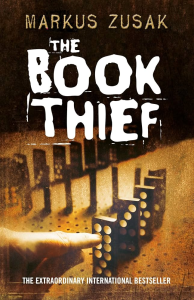
Ever read a book narrated by Death? I have, sort of, only Death didn’t know he was Death. He accidentally walked into the job, but that’s another story. But this is a book narrated about Death proper, and he’ll have plenty to talk about because it’s set in Germany, on the eve of the Second World War. A young girl has just witnessed her brother unexpectedly die as her impoverished mother is surrendering her to foster care, and is forced to grow accustomed to life in a new family & place. The place is Himmel Street, a poor neighborhood in a suburb of Munich, and despite the persistent threat of poverty, Liesel will indeed find friendship and meaning — though, in her case the latter takes the form of a habit of book stealing. The Book Thief is an unusual and compelling story of friendship and the transformative potential of literature and words, set amid the outbreak of World War 2 and the beginnings of the Holocaust/Shoah.
The Book Thief has a curious structure, with frequent asides from the narrator — comments, art, definitions — and lots of overt spoiling of future events, mostly people dying. Of course, given the narrator and setting, it’s easy to assume some of the main characters will die, but we don’t know who. Even with that hanging ominously in the corner of the mind’s eye, the story is compelling and lovely: Liesel’s foster parents are two very different people, and love her in different ways (Papa is much easier to like than his wife), and they both display moral courage as Hitler’s hateful policies become visible on the streets of their city. Liesel’s friendship with a neighbor, young Rudy, is also fun: he dreams of being as fast as Jesse Owens and flirt-fights constantly with her. A key part of the novel is the family offering shelter to a young man whose father served with Papa in the Great War: Max is Jewish, and needs to hide from the state. Although this puts everyone at risk, Papa’s debt to his late comrade, as well as his immutable decency, make this hiding a moral necessity. Max and Liesel bond over books, and it is that love which saves Liesel in the end when carpet-bombing finds her town.
This is a story both sad and sweet: unforgettable, to say the least.
Highlights:
Clearly,” said Arthur, “you’re an idiot—but you’re our kind of idiot. Come on.” They were in.
“When death captures me,” the boy vowed, “he will feel my fist on his face.”
“I am stupid,” Hans Hubermann told his foster daughter. “And kind. Which makes the biggest idiot in the world.”
His soul sat up. It met me. Those kinds of souls always do—the best ones. The ones who rise up and say, “I know who you are and I am ready. Not that I want to go, of course, but I will come.” Those souls are always light because more of them have been put out. More of them have already found their way to other places. This one was sent out by the breath of an accordion, the odd taste of champagne in summer, and the art of promise-keeping.
I am haunted by humans.
Related:
The Hiding Place, Corrie ten Boom
Bomber, Len Deighton. A novel about a bombing run over a fiction village in Germany. Lauded for its technical accuracy.

 Reading Freely
I’ve heard nothing but amazing things about this book! I really like the concept of Death being the narrator though in this situation that seems dark rather than funny or whimsical.
It was compelling enough that while I began with a physical copy, after lunch I checked it out on Kindle via my library so I could read it from my desk during quiet moments. 😀
haha I guess that’s how you know it’s good, if you don’t want to be parted from it!
I’ll get around to this at some point… Probably…. [grin]
I’ve seen the film for this one but still majorly need to read the book. I’m quite intrigued by the writing style that you’ve described. I knew that it was narrated by Death but all those little asides and similar features make it sound even more unique.
I’m curious about the film — are the characters’ expressions punctuated with German? German expressions (especially vulgar nicknames for characters) are a big part of the novel.
It’s been ages since I’ve seen it (probably around a decade as it wasn’t that long after it came out) so I can’t really remember. What you mentioned sounded vaguely familiar so I looked at the Trivia on IMDB and it did mention a couple of names being used for certain individuals.
Okay, thanks! I’m planning on watching some German film (or films set in Germany) in October, so I’ll try to include this one.
I hope it ends up comparing well to the book then. I also thought The Aftermath was good.
I love how this story blends the sadness of war with the power of books and friendship. The idea of Death narrating makes it so unique and unforgettable!
Doris/ Pure Life Gem
I am very sensitive to that period, so I had to skip this one
Quite understandable.