
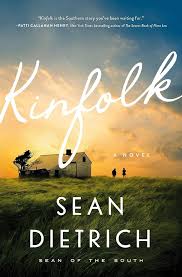
It’s the early seventies. Come to rural Park, Alabama, a town that don’t have much goin’ on except its occasional American Legion meetings, a place that ain’t even on most maps. There’s a fella, Nub, and everyone knows he’s the town drunk who don’t mean no harm except sometimes he does silly things like mooning the cameras and peeing in pools and other stuff that makes him feel stupid when he wakes up in jail the next morning. That’s ok, though. Nub ain’t bad, he’s only bein’ hisself. He’s a good musician, can play anything with strings, but he hasn’t been doing it much lately. He’s got an ex-wife who kept him away from his daughter, a daughter who don’t realize he was an absentee father for reasons beyond his ability to change, and a powerful thirst. Nub ain’t too much satisfied with life lately, and when he’s hospitalized for running full-speed into a water tower (it’s a long story) and then roomin’ with a young teenager who keeps singin’, he finds himself inexplicably interested in her life. His timin’ is nice, because her mama just shot herself and now young Minnie’s got nobody interested in her. That especially includes the society jerk who sweet-talked her into intimacy and then left her in the family way. (That means with a baby.) There is her daddy, but he’s hidin’ in the woods from the law, and from some serious criminals he used to run around with. Kinfolk is a tragic, sweet story about family: those we’re born into, those we choose. Both of its principal characters are haunted by their parents’ suicide, and them that know Sean’s backstory will see his pain written into their lives, as will they see his wife’s own cancer scare written into the life of another character. And then, there’s gangsters who like burnin’ down houses and such if all that ordinary human drama ain’t enough for you.
I have only known Sean Dietrich as an author for barely a year and a half now, but I follow his substack and I’ve read most everything he’s written because he manages to find grace in the worst tragedies. That’s a recurring theme in in what he writes — on substack, in his novels, and in his newspaper columns. It’s especially true in this work, which presents an array of characters who are almost confusing in their abundance until they begin settling down into one another’s lives. Sean is sweet and insightful, a potent combination that means I keep buying his books to give to other people as Christmas gifts. I first encountered this side of Dietrich through is The Incredible Winston Browne, and it it’s strong here. We’re set in the small town of Park, Alabama, or — judging by Nub’s botched paint job on the water tower, Papk. There’s Nub, of course, the town drunk who makes ends meet by doing odd jobs for the city: his daughter Emily, a socialite widow who has breast cancer only no one can know it; Leigh-Anne, the barkeep down at the Legion who’s actually an AA member; Minnie, an orphan of a woman who killed herself and a career criminal; and Shug, the aforementioned criminal who nobody knows is hidin’ in the woods and attracting all manner of adverse attention to poor Minnie; and a few others. Their lives all grow together into a compelling story that ends in Dietrich’s signature mix of joy amid sorrow. It’s a good read — I began it at lunch and continued obsessively once I was off work — and depicts flawed people finding one another and growing together despite their weaknesses, simply because they are willing to put aside ego and pragmatism and just do what feels like it needs doin’. One attraction of the novel is that everyone’s flawed, most everyone knows it, but people generally love each other just the same: Emily knows her dad has his problems, but when he begins trying to be worth a damn, she resists her hope only to a point for surrendering to the hope that he might grow beyond his past limitations. And people do change — we change each other. That’s a central lesson, here.
Anyway, I liked it.
(This entire review is written under the premise, “What if Sean Dietrich Wrote A Book Review?”)
Some quotes and highlights:
“Is this the same man who once danced on the bar wearing a lampshade as a hat?”
“I never did that.” She just looked at him.
“It was a cardboard box,” he said. “Not a lampshade.”
“Benny,” said Nub. “Don’t take this the wrong way, but you’re kind of embarrassing me.”
“Thanks. That means a lot coming from a professional.”
“I’m just trying to act right; that’s all I can do. Act. I think I’ve finally learned that you can’t think your way into the right action but you can act your way into the right thinking”
Even in dire circumstances when it would have served him better to be disingenuous, Nub Taylor was sincere. His greatest quality, however, was that he had the audacity to be himself, for better or worse. Something she could never do. She was too busy being other people.
“Well, I didn’t want her first meal in this house to be pork and beans with ketchup.” “That’s not fair. We were going to have Hamburger Helper.”“You mean you ain’t going to drink no more?”
“I mean I’m taking it one day at a time.”
“But if you don’t drink no more, then how come you got beer in your refrigerator?” “Hard to say goodbye.”
“And you got a lot of whiskey under your kitchen sink too.”
“What are you, the Southern Baptist Convention?”It was a sacred melody of the heart. A human being spends most of his or her life hiding behind things, hiding behind their own words, pretending to feel ways they don’t really feel, trying to convince themselves that everything is okay. But if you want to know what’s truly on someone’s mind, what’s eating them inside, you pay attention to what they sing about. The truth always comes out in music.
“But you know what?” Nub went on. “I’ll get over my embarrassment. Because if there’s one thing I’ve learned, it’s that you can’t save your ass and your face at the same time.”
The two deputies looked at each other. “Anything you can tell us might be helpful,” said Burke.
“Okay. Deer mice are the most common mammal in North America.”But then, life was full of overlooked miracles. And miracles never happen the way you expect them to. They are softer than a baby’s breath. They are, at times, as noticeable as a ladybug. A miracle is not a big thing. A miracle is millions and millions of small things working together. But then, this didn’t matter. Not really. Because Minnie had come to believe that life was not about finding miracles, or happiness, or success, or purpose, nor was it about avoiding disappointment. It was about finding people. People are what make life worth it. People are the buried treasure. People who understand you. People who will bleed with you. People who make your life richer. Your people. Your kinfolk.
Music:
There’s a lot of old-time country and southern gospel tunes sung in this book, so here you go for flavor:

 Reading Freely
Ah I came on here just to find this review, I was curious how you ended up liking this and I’m glad to know it didn’t disappoint. I enjoyed reading your review and the flawed characters in here sound fascinating to read about especially Nub. I listened to the Grand Ole Opry video you included and it was fun!
Featuring at the Opry is STILL a “Made it” moment for country musicians to this day. Glad you liked it!
That’s cool, I can only imagine! 🙂
Pingback: Various & Sunday Tuesday Memes | Reading Freely
Pingback: September 2024 in Review | Reading Freely
Pingback: Top Teddy Tuesday | Reading Freely