
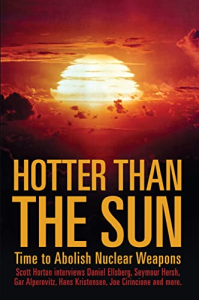
Nearly eighty years ago, a single B-29 bomber flew over the Japanese city of Hiroshima and dropped a single bomb, baptizing humanity into a dark new era once the blinding white glow had ended. In the fifties and sixties, the amount of nuclear weapons soared to absurd numbers — an estimate of 70,000 bombs between the two powers. While the number of nuclear arms has fallen since the height of the Cold War, governments still possess more than enough to destroy the world many times over — whether through deliberate stupidity and malice, or through broken-arrow incidents, and three powers (DC, Russia, and China) are actively expanding and sinking their wealth into means of global death. Given that two conflicts are currently raging that could easily escalate to catastrophe, it’s never been more important to attack this existential threat. Scott Horton, who has been host of Antiwar Radio and conducted thousands of interviews since 1999, here offers transcripts of those interviews that have a nuclear connection — either because they discuss weaponry and treaties directly, or because they delve into geopolitical issues that might serve as a flashpoint. The guests include former war planners like Daniel Ellsberg, nuclear industry engineers and publishers, US army scientists, and foreign-policy experts. Although not a conventional narrative, it’s a fascinating and varied blend of politics, history, and technical analysis.
A key recurring theme here is that any use of nuclear weapons poses a threat to the entire population of Earth, either through damage to the atmosphere, radioactive drift, or — in the case of escalation — a global holocaust followed by a nuclear winter that will kill all life on earth except for cockroaches and Raytheon lobbyists. Given this, it’s insane that governments are not only moving to a first-strike posture (i.e. we’ll launch on the threat of a launch, not merely in retaliation) and to systems that can respond automatically. Given the state of the United States and Russia, it’s dismaying and enraging to realize how many billions are being thrown at new whizz-bang systems when the means already exist to destroy humanity multiple times over. A second key point is that the military-industrial complex and politicians connected to it are deeply invested in maintaining and expanding nuclear arms. Obviously, a firm that has ungodly amounts of money sunk into creating nuclear weapons doesn’t want governments to suddenly stop buying them, and even if they weren’t finding ways to compensate politicians directly through electoral donations and the like, those politicians still rely on the MIC to provide jobs for the people who vote them in. The interviews span nearly twenty years, which allows for some interesting and often frustrating perspectives. Horton and several guests were excited about Senator Obama’s frequent mentions of the need for nuclear disarmament, but later — whoops! — now Mr. Peace Prize is authorizing billions to ‘modernize’ DC’s armageddon arsenal. A lot of interviews are set around the original Ukraine crisis in 2014, which itself is the reason for the current war. This was an extremely informative book across multiple fields: I’d never heard of the ‘nuclear sponge’ principle, for instance, in which the plains states were chosen to site major ICBM locations in hopes that the Soviets would prioritize nuking them over American cities. And they say DC never thinks about flyover country! In addition to examining various geopolitical factors that lead to international tension and the possibility of nuclear war — Iran and Israel, India and Pakistan, and so on — Horton and his guests also discuss at length the culpability of DC in making tensions worse, either by scrapping existing treaties (W, Trump) or shoving missiles deeper and deeper into Eurasia (Everybody…) On the bright side, we do get to witness moments like Reagan and Gorbachev dramatically reducing nuclear stocks (and coming very close to discussing total disarmament), and I was surprised to learn that many high-ranking military officials (Eisenhower, MacArthur, and even Curtis LeMay) were against the bombing of Hiroshima, seeing it as morally rephensible and militarily unnecessary. Given that MacArthur and LeMay were both willing use the Bomb with gusto during the Korean war, that says something about how cold-bloodedly malicious the Autumn ’45 bombings were.
Unfortunately, in the present climate, it’s unlikely any progress will be made, as there are no strident disarmament voices on either side, even from anti-war figures like Paul and Massie. That makes this a grim book to finish — but it’s chock full of interesting information, and is easily my favorite of Horton’s published transcripts books. Do check out his podcast if you’ve any interest in world affairs, geopolitics, or DC’s foreign policy. Scott has two books on the Terror War: one focusing on Afghanistan, the other on the war in general.
And alas, it has added to my interest list.
Highlights:
The Hiroshima bomb had the explosive power of 13–14,000 tons of TNT—in other words, more than a thousand times the 10 tons that were in the World War II blockbuster. What I don’t think many Americans realize to this day is the difference between an A- and an H-bomb, the difference in scale. The first real test of a big bomb in the mid-’50s had the explosive power of 15 million tons of TNT. In other words, a thousand Hiroshimas. (Daniel Ellsberg)
Because by every account, Cheney wanted to attack Iran with nuclear weapons on their underground site right through the term, and it was Bush, of all people, that we relied on. Well, I think that shows the situation that humanity is in, when our survival depends on the prudence and judgment and wisdom of a George W. Bush, wherein the species—and
this is not rhetorical—the species is in very deep trouble. There’s no if there; that’s where we are.(Daniel Ellsberg)So, we’re doing a lot of things that are going to have long-term effects that we haven’t really weighed, and we have a constitutional issue in this country. Supposedly, tariffs are under control of Congress, not the president. The reason the Founding Fathers did that is that they wanted a deliberative process before we did this sort of thing we’re doing now, announcing policy with a tweet in the middle of the night, which is exactly how some of this has been announced. So I think the Congress—which has defaulted on many, many issues, from the ability to declare war to the ability to set tariffs and regulate trade—needs to do what we pay them to do, which is to debate, decide, have hearings, educate, shape policy and monitor it, and not just to default to the president. (Chas. W. Freeman II)
Horton: I think probably to this day, most Americans don’t know about the firebombing of Tokyo. The censorship has lasted.
[Anthony] Weller: I think there’s very little in that story that people want to know about—from the firebombings, to the atom bombs, to the POW camps— which were horribly brutal. Notice that the Nazi POW camps have entered the kind of cinema mythology, but the Japanese POW camps, which were seven times deadlier, have not. [*] The hell ships are virtually unknown, the war trials are virtually unknown; and the fact that the Japanese carried out biological experiments just like the Nazis and that MacArthur enabled a lot of those scientists to come to America and become pharmaceutical magnates. They traded their freedom for the secrets of their experiments in case we needed help with tortures of prisoners in the future. All this stuff is unknown.We have a military-industrial-congressional complex that lives off inflated threats and inflated responses to those inflated threats. That’s just a fact. We use the defense budget like a jobs program; it doesn’t derive from specific analyses of issues that we have to deal with. It’s a “more is better,” basic philosophy. We never could spend enough, and the fact that we have been spending so much money—$6 to $7 trillion on wars in the Middle East that we can’t win and won’t win, and that produce nothing—is exactly why we have a $4 trillion infrastructure deficit in the United States. It’s the reason why we have been disinvesting in our educational system, science and technology, and research and development outside the military sphere. This is not a formula for national success. Our allies, the countries that we protect, like Japan and the Europeans, have been very sensible. We offer them a free ride, and they’ve taken it. They put their money into stuff other than military equipment and preparations for war, and they’re doing pretty well. (Chas W. Freeman II)
“People are speaking about the “Sanctions from Hell”—and it’s nice to catch the news with terms like that—and it’s not just Americans; Western Europe also is persuaded that economic warfare is just an alternative to kinetic warfare. What they are ignoring is that in our own past, economic warfare became kinetic warfare. We wouldn’t have had Pearl Harbor if we hadn’t been waging a fierce economic war against Japan to deny it access to raw materials. That’s one thing. A trade war can become a real war, and a conventional war can become a nuclear war. Putin has said very straight that if the survival of Russia is in question, he will go nuclear. (Gilbert Doctorow)
Well, the Russians aren’t bunny rabbits, and anybody who thinks that they’re nice and cuddly is making a serious mistake. But there’s no reason why they should be cuddly. They are realists. They’re defending their own interests. We are not considering other people’s interests, and that is the key error, the key fault, in our foreign policy—that the rest of the world does not exist, that there are only American interests. That is not sustainable. That is not realizable. And it can get us into serious trouble. (Doctorow. Emphasis added by me.)
It’s funny to think about: George H. W. Bush might, in a sense, be quantitatively the greatest man who ever lived. He went and signed deals that eliminated tens of thousands of nuclear weapons from our arsenal and from the Russian arsenal as well. That’s actually, if you think about it, the greatest accomplishment of any two men in a room that ever happened. They got rid of a grand total of something like 60,000 H-bombs. It’s incredible to think that the American and Soviet arsenals were ever built up to those kinds of numbers in the first place, but what a legacy, and what a legacy to invoke! (Scott Horton)
It’s absurd that there should be this obsession with Russia when the total Russian defense budget, which is roughly $61 billion, is less than the amount the U.S. defense budget goes up in a year. It’s ridiculous. (Andrew Cockburn)
You’ve got some Pakistani colonel on the Indian border, and he’s going to make a decision as to whether or not we’re going to destroy 70 percent of the Northern Hemisphere’s ozone. It’s really not a place we want to be, and there should be an international full-court press on stopping this, on reversing this, and it could be done. – Conn Hallinan
Horton: The U.S. has this weird relationship with Israel about their nuclear weapons, where we pretend to be ignorant. The West pretends not to know that Israel has nuclear weapons. But the deal is they’re not members of the Non-Proliferation Treaty, and they don’t openly declare that they’re a nuclear weapons state. It’s a “strategic ambiguity,” that’s their diplomatic term for it.
Smith: Right, that’s their policy, and it’s because of the power of the lobby and Israel’s desire to keep this kind of thing “away from the kids” that we are complicit in that ambiguity, and it makes a lot of other moving parts of the U.S.-Israel relationship possible. If the U.S. were to come out and openly say that Israel is a nuclear weapons state, immediately, the Symington and Glenn Amendments to the foreign aid law would kick in, and the U.S. would no longer be able to deliver any taxpayer-funded military or civilian aid to Israel.
[*] Note this claim is for prisoner-of-war camps, not the civilian death camps that murdered 11 million people.

 Reading Freely
Oh, there’s ZERO chance of any nuclear power giving them up. It *might* be possible to stop new countries getting them but once they do…. I guess they only way to really get rid of them is to make them obsolete and therefore an obvious waste of money. Just how you would do that – without actually starting a nuclear war – is a conundrum!
Of course even if you had a 100% effective anti-missile system, all you would need to do is use a nuclear truck bomb or stick one on a container ship with a GPS trigger and sail it into an enemy port of choice. If a terrorist organisation did that they’d get the added bonus of eliminating seaborne trade until whole ship scanners could be deployed well out to sea…
Reagan, Bush, and Gorbachev got rid of most of the existing stocks…can definitely see every NP wanting to keep like a hundred in reserve or so, but any progress we can make is worth it. Frankly, they’re already obsolete: they have no purpose. No one wins if the Earth is destroyed. One big problem, I think, is nuclear arms falling into the hands of irresponsible parties if a nation-state breaks up. Really glad Russia had gotten rid of so many before the fall of the USSR.
I think that the odds of a general nuclear war are very low (not zero, but LOW). It’s possible that two nuclear powers *might* lob a few at each other – I’m thinking India/Pakistan – but I doubt very much if something like that will either last very long or spread. I think it’s highly likely that some non-state actor will explode a nuke somewhere in the next 10, 20, or 30 years. Probably in the Middle East, possibly Europe or the US…. It’s only a matter of time really.
Once we had nukes and knew what they’d do in a shooting war they pretty much became designed *not* to be used. That doesn’t make them obsolete. It’s the whole “balance of terror” idea. Their ‘use’ is the deterrent factor – both stopping other people using/threatening them against you or pushing a country *too* far into a corner where their use becomes a feasible last response…
The problem is (as Horton alludes to here) is that the generation of politicians and admins we had in the sixties, seventies, eighties — people who KNEW what nukes could do — have aged out and they’re replaced by relative kids who have no real idea of the dangers. We stopped talking about nuclear winter in the 1980s.
Possibly… But no one *knows* about fighting even a ‘limited’ nuclear war. The only experience we’ve had are the two bombs dropped on Japan – which would be considered small battlefield weapons these days. Certainly plans were in place to fight (and win) a nuclear war in the 70’s and 80’s but a lot of that was speculation.
I think even today’s politicians are aware of how potentially dangerous the use of nukes is. I doubt if they’ll be used – by any reasonable military – except as a very desperate last ditch response. I don’t believe that any nuclear power is seriously planning on using them any time soon or, indeed, would feel that their use has become necessary in any reasonably conceivable scenario.
They say countries only want nuclear weapons as deterrents. Hopefully that will always be so and none will want to actually deploy them.
Harvee https://bookdilettante.blogspot.com