
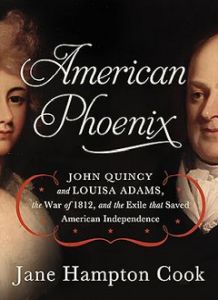
John Quincy Adams was the eldest son of John Adams, who followed the elder’s irascible devotion to principle and found himself an exile for it — after his support for a general embargo against European powers for continuing to harass American shipping and forcibly conscript American sailors, he lost his senate seat and was dispatched to the outer rim of western civilization: St. Petersburg. After a rough transit over — whereupon he learned that the Danish were just as bellicose as the Brits and French, seizing American shipping under the willfully-wrong belief that they were English. (The Brits added to the confusion by frequently running up the Stars and Stripes.) Over the next few years, the Adams would settle into their role as America’s voice in St. Petersburg, growing in the esteem of the Russian court even as trade traction was rough going in the constantly changing sea of Napoleonic politics. One moment Tsar Alexander and Napoleon are chummy, the next Napoleon is marching troops toward the border and Alexander is giving Portugal meaningful looks from across the room. The first half of this book is a little slow going — not for the quality of the writing, but for the fact that very little happens. St. Petersburg is iced in most of the year, and the action largely consists of John and Louisa trying to woo European officials — and to keep Alexander from more intimately wooing Louisa’s young sister Kitty Johnson. Evidently she set every red-blooded male’s heart a-flutter. I was surprised to learn that John Quincy was appointed to the Supreme Court, but turned it down despite his hopes of escaping cold, expensive St. Petersburg: the timing of it would force Louisa to possibly give birth at sea, not a chance he was willing to take given that she was frequently in poor health and prone to miscarriages. I was gladdened to see a man who has his priorities in line — family over pelf and place — but not surprised given the esteem I hold the Adams family in, generally. The anguished distance from family and the privations of their position — with infrequent and low pay — nevertheless allowed John and Louisa to build relationships with Europe’s diplomatic ranks, which bore fruit in giving Adams the gravitas and trust to negotiate the Treaty of Ghent, which ended the War of 1812 and ultimately secured American independence from George III. Although this volume isn’t without its deficiencies (particularly the constant reminders that they had no telephone or internet), it’s an interesting look into part of the early Republic I was otherwise oblivious to, and a heartening look back at a time when public service was literally service, often sacrificial, and not merely a way to build up one’s coffers or luxuriate in acclaim.
Highlights:
Writing was the key to being remembered in their generation. Photography didn’t exist in their heyday, much less the concept of video. They understood the sentiment behind Benjamin Franklin’s quip: “If you would not be forgotten, as soon as you are dead and rotten, either write things worth reading, or do things worth the writing.” John Quincy and Louisa Adams did both.
“But upon the stage of life, while conscience claps, let the world hiss! On the contrary if conscience disapproves, the loudest applauses of the world are of little value.” – John Adams
But we know how much the Moniteur is to be believed and certain deductions are to be made from whatever that contains.” “To be sure, people were very apt to publish as fact what they had an interest and a wish to believe,” John [Quincy] said to him.
“Again at the house with Mr. Adams to arrange books and papers—Slow work for he reads a page in every book that passes through his hands.”

 Reading Freely
I share your esteem for the Adams family, one that extended from the eighteenth into the twentieth centuries. This book sounds like an interesting portrait of some of the important aspects of Adams outside of his years as President.
Yes, though it’s just focused on this particular hour of his life — he was also a notable anti-slavery advocate and presided over the Amistad case.