
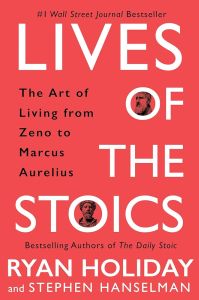
Some seventeen years ago I discovered The Meditations of Marcus Aurelius and the Discourses and Handbook of Epictetus. Neither men meant to publish these: the first was a private diary that was publically shared after the Emperor’s death, the second two were produced by a follower of Epictetus who converted his notes taken during discussions and lectures into more formal texts. That followers and admirers of these men went to these efforts to pass on their principles and teachings says much about the quality of the men and what they professed. In Lives of the Stoics, we meet both men again, but in the context of their community, as this series of biographical sketches also tracks the evolution of Stoicism from its beginnings with Zeno and Chrysippus, with a focus on individual virtue, to its growth as a publically-minded philosophy as advocated by Seneca and embodied by Marcus Aurelius. I’ve previously read Holiday and have avoided him since, regarding him as the Joel Osteen of Stoicism. This book appeared in my library’s bookstore, though, and given my interest in learning about Stoics beyond those I’ve read books by, I decided to give it a try. Although there’s still a life-coach vibe here, and Holiday plays to the reader’s existing pretensions rather than challenging them, I enjoyed this more than anticipated — in large part because so many of the names were unfamiliar to me, despite having read broadly into Stoic writings.
Lives of the Stoics follows the model of Plutarch’s Lives, offering a brief biography of each man (and one lone woman) and stressing the lessons to be learned from them. Because the biographies are meant to be inspiring — presenting us with a standard to attain to — there’s a background level of narrative flourish, shall we say, that turns stories into facts and casts each man in as warm and favorable a light to the reader as possible. As mentioned in the introduction, the first half of the book nicely demonstrates Stoicism’s early evolution from one focused on an individual becoming a sage, to a philosophy that also emphasized man’s inbuilt responsibility and integration with his community, —oikeiôsis, or as Wendell Berry might put it, “membership”. The version of Stoicism that Holiday preaches here, via the biographies, is a simplified one that emphasizes the dichtomy of control, alongside individual integrity and duty. The latter two are interwined, as a great many of the figures in this book’s second half are executed by Nero for refusing to go along with his programs. They include, at long last, Seneca — who entered public service as a tutor to young Nero, who was distracted by his study of philosophy by worldly responsibilities and riches, who withdrew from them only to still find himself marked for death by the emperor. Another man here who does not cut so fine a figure is Cicero, who studied Stoicism and whose writings help convey it to succeeding generations, but who never fully took its lessons to heart and stood silently by as Caesar destroyed what was left of the old Republic. The men (and woman) in this group were very much a community, with few isolated individuals: in the beginning, there’s a steady progression of teachers who train their successors, and in latter half we realize Rome was swimming in Stoics, from slaves like Epictetus to men so connected with the Judeo-Claudian line that Nero exiled and then killed them to prevent challenges to his regime. These men knew each other, were part of one another’s lives: Musonius Rufus followed one fellow Stoic into exile, for instance, and another killed by Nero was an associate of Seneca’s — and Seneca’s writings in the library of Nero’s secretary may have exposed Epictetus to Stoicism, while Hadrian and Rusticus’ interest in Epictetus exposed Marcus Aurelius. Holiday tries hard to connect the lessons of these men to examples that contemporary readers might be more familiar with — using a quote from East of Eden to illustrate Cleanthes’ appreciation of manual labor, for instance, or comparing Seneca and a modern general who served a president he didn’t especially like, but felt needed his contribution.
While I wouldn’t recommend this for someone looking to be exposed to Stoicism, if one is already interested in and familiar with its core concepts, then Lives shows us how philosophy may look in practice — from men and women making choices out of principle, not self-interest, to their enduring hardship and staring death squarely in the face, laughing at poverty and approbation at the same time. I enjoyed meeting this range of characters, especially those who I’ve read but know nothing of (Rufus), or simply ‘spending time’ with men like Cicero, whom I like despite their weaknesses. As a longtime student of the Porch, I was fascinated by some of the figures in its early history, whose lives and thinking had more overlap with the Epicureans and Cynics than the more sharply defined Stoicism of later years.
Coming up: I’m beginning a NetGalley ARC called Lawless Republic: Cicero and the Fall of Rome, as well as continuing in a book on volcanos. Review for A Prayer for the Crown Shy is also coming.
Quotes:
Perhaps [Epictetus] so landed with Marcus Aurelius because they were both dealt hard hands by fate. It is a striking contrast, an emperor and a slave sharing and following the same philosophy, the latter figure greatly influencing the latter, but it is not a contradiction — nor would it have seemed odd to the ancients. It’s only in our modern reactionary, divisive focus on ‘privilege’ that we have forgotten how much we all have in common as human beings, how we all stand equally naked and defenseless against fate whether we possess worldly power or not.
Related:
Marcus Aurelius: A Life, Frank McLynn
The Emperor’s Handbook, Stephen Mitchell. A modern-English translation of the Meditations. Hays’ is best, but I’ve never reviewed it here.
The Art of Living, Sharon Lebell. An interpretation of Epictetus’ teachings.
Dicourses and Enchridrion, Epictetus.
How to Live, a modern-language adaptation of Musonius’ Rufus’ lectures.
Dialogues and Essays, Seneca
Letters from a Stoic, Seneca
The Spiritual Teachings of Marcus Aurelius, quotes and commentary on the philosopher-king

 Reading Freely
I’ll take this as my periodic reminder to read a bit less History and a bit more Philosophy… [grin]
I’ve been a paltry in it lately, myself!
I bought this during a Kindle sale, though I have yet to crack it open. Thank you for sharing your thoughts.