
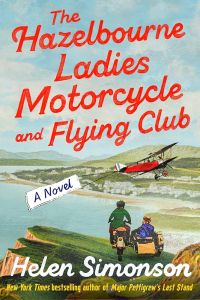
Constance is a young woman who’s just arrived in Hazelbourne, there to take care of an older family friend who’s just had a bout with flu. She enters into a new social circle thanks to this connection, and despite the gap in their backgrounds, Constance quickly make friends. One friend in particular, Poppy, introduces her to another world entirely: that of the Hazelbourne Ladies’ Motorcycle Club. During the war, Poppy and her friends were dispatch riders for the government, roaring around on their motorcycles to deliver important messages. Now that the war is over, that work is ended — and other women who had taken up spots vacated by men who were being sent to the slaughter are also being cashiered out to make room for those boys who served, from public transportation to accounting firms. Rather than sit around and gripe, though, the dynamic Poppy and her friends have created both a social club and a business organization: offering motorcycle repair, training, and taxi service. Such is the premise of this unique period piece, set immediately after the First World War when Britons young and old were reeling from the chaos of the war and the change it set in motion: while not a patch on Major Pettigrew’s Last Stand, it’s still a sweet story with memorable characters.
We here follow Constance and Poppy throughout the summer of 1919, in a Britain still trying to adjust to the end of the great war. Its remnants are everywhere: a German U-boat lies stranded on the beach nearby, and Poppy’s own brother Harris lost his leg in combat and now struggles with grief for himself, and despair over an inability to find a way to pitch in: everyone seems to want him to just roll over and play the good invalid, to ‘rest’ and perhaps write morbid poetry or something, when he wants to take to the air again, or at the very least go back to work in an office. One strength of this novel is the relationships it is built on, particularly that between Poppy and Harris: though they constantly mock one another, Constance sees clearly that they love one another. Poppy’s is a bit of a gadfly: she doesn’t want her brother surrendering, she wants him to keep fighting to have a life beyond his status as Disabled Veteran, wants him to overcome the resistance pushed on him by everyone else. Poppy’s dynamism, her refusal to become some background ornament, demonstrates another theme of the novel, that of change. The economy is changing, and so is culture: social roles are changing. Poppy constantly pushes against the envelope, and following in her wake Constance finds courage of her own. To me, Poppy was the dominant character in the novel: it is she who buys the airplane, for instance, that a lot of the novel’s second half is built around, including the growing relationship between Constance and Harris. The core of the novel is the relationship between Constance and these two siblings, especially given the gap in social classes: this leads to an unexpected and interesting ending that becomes a little more predictable with the epilogue. I did have some quibbles about the novel: Simonson has one airman talking about mixing it up with Jerrie over the channel, which is….dodgy in the extreme. Germany did send over Gotha bombers and zeppelins, but the air war was largely staged over the trenches, in direct connection to trench warfare. I think Simonson may have been thinking of WW2 in that particular instance, but that’s forgivable given that this isn’t a work of military fiction, and that the Battle of Britain must have a dominating presence in the historic reckoning of British writers.
Hazelbourne was a fun novel to read, and I’m looking forward to Simonson’s remaining work, The Summer Before the War.

 Reading Freely
Oh, *definitely* mixing up her World Wars! The fighters used by both sides of that period didn’t have anywhere near the range to clash in the Channel – plus (of course) the Germans only occupied part of northern France in WW1, rather than the whole lot including the Channel coast. Interestingly, the squadrons pulled back to England for Home Defence against the Gotha bombers later on laid the foundations for Fighter Command in the Battle of Britain.
I’ll be reading this soon, so I’m pleased you liked it despite the inaccurate military history! I can definitely recommend The Summer Before the War – I think I preferred it to Major Pettigrew, which I also enjoyed.
I think it was Summer Before the War of this author that I enjoyed a lot.
Pingback: What I Read in 2024 | Reading Freely