
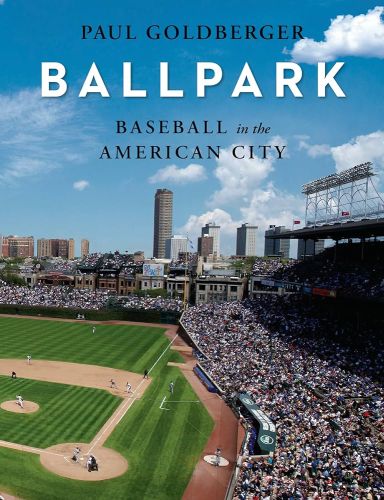
Regardless of one’s personal beliefs about the origins of baseball, there’s no getting around the fact that the game as we know it is a product of the cities, particularly New York: the cities were where the people were, and when they wanted to get away from the noise and pollution (be that smoke or horse manure), the ballpark was the place to go — a mix of country and city, the two held in tension. Ballpark is a history of the sport in the context of the city, with an interesting variety of commentary: a history of evolving architecture itself, which is tied to how the ballparks interacted with their host cities, and of citizens’ relationships with their town’s teams. Baseball began as a hyperlocal sport, and towns remain devoted to their teams — more than the teams are to them, as the faithless Dodgers showed. The parks, too, can become bound up with local identity, and some cities like Boston have taken advantage of that: when I think of Boston, I think not of the Old North Church, but the Green Monster in Fenway Park. It and Wrigley Field are the only legacy ballparks still around, others having been lost to ‘progress’, or simply torn down for no purpose whatsoever, like old Tiger Stadium. (You want a new park that has high-priced executive rooms and more room for selling merchandise, fine, but if the only thing to be done with the site is kids playing sports, they can play sports in a ballpark that Gehrig and Ruth batted in! But I digress into harrumphing.) The book’s big theme is how ballparks’ relationship with cities has gone through four stages over the last century or so — engagement, distance, re-engagement, and now actively orienting the town around the stadium, and there are some fascinating little phases covered on the way. I never knew so many cities tried to force teams from different sports to use the same field, resulting in a field optimized for neither sport and known chiefly for looking like an ugly concrete donut. There are a lot of good photos of the parks themselves, and I was interested to learn about the new Braves park, which is creating a neighborhood around itself — an interesting fusion of public and private space. I’ve seen the Braves play at Turner Field (now retired), but haven’t seen the new park yet. This was an interesting genre blend of baseball history and urbanism!

 Reading Freely
Pingback: The Best of 2024 – Year in Review! | Reading Freely