
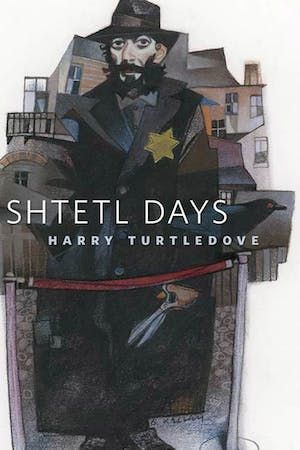
“We will do, and we will hear”. Such was the people’s reply when Moses descended from Mt. Sinai and presented the Ten Commandments to the Hebrews. There’s an inversion in that statement, alien to our modern age: imagine doing a thing before understanding why But, as Shtetl Days indicates, sometimes the beauty of a thing cannot be appreciate until it is engaged with. This is a novella set in roughly the present day, but in a world where Nazi Germany was victorious in what it calls the War of Retribution, and apparently successful in destroying most of the Jewish people. It is so successful, in fact, that it’s created a living-history village where tourists can come see how mid-20th century Poles and Jews lived, populated by method actors living as though they really are Poles and Jews. Veit Harlan, for instances, spends the majority of his time living as Jakub Shlayfer, an observant Jewish tinkerer. He talks in Yiddish to his fellow actors in the village, he argues Talmud, he says his prayers before every meal. Some actors are so committed to the part that they have themselves circumcised. Most of the actors are so immersed in their parts that they tend to live in a shadow of them even in their offtime, defaulting to Yiddish, thinking about and discussing Torah, and even saying a prayer over their food reflexively. The story follows Veit/Jakub as he rests after the annual pogram reenactment — in which the Polish actors begin rioting and beating the Jewish actors and even burning the Jewish quarter, although the only ‘actors’ who are killed are convicts who are introduced into the act for the purposes of being executed – and begins reflecting on the strange way he relates to being Jakub, on how what we think about and do shapes us. More interestingly, he admits to himself that he likes being Jakub more than he likes being himself: he likes living in a cozy, tight-knit community, likes living in a constant attitude of mindfulness and thankfulness, likes the dancing order of liturgy. What does it say of the Reich, that it had to destroy such things, such a people? His ‘life’ as Jakob isn’t clean and orderly as his life as Veit — he’s poorer in many ways — and yet there is a richness in this little village that surpasses those of the best of the Reich’s cities. I haven’t read Turtledove in nearly ten years because he’d gotten very lazy (The War that Came Early and Supervolcano were enough to put me off reading him altogether), but the premise of this one seemed interesting enough to give it a shot. I’m glad I did: it really brought to mind a quote from Narnia that I’ll post below a quotation from the story.
You needed to ignore the funny clothes. You needed to forget about the dirt and the crowding and the poverty. Those were all incidentals. When it came to living with other people, when it came to finding an anchor for your own life… He nodded once, to himself. This was better. Even if you couldn’t talk about it much, maybe especially because you couldn’t, this was better. It had taken a while for Veit to realize it, but he liked the way he lived in the village when he was Jakub Shlayfer better than he liked how he lived away from it when he was only himself.
Shtetl Days
“One word, Ma’am,” he said, coming back from the fire; limping, because of the pain. “One word. All you’ve been saying is quite right, I shouldn’t wonder. I’m a chap who always liked to know the worst and then put the best face I can on it. So I won’t deny any of what you said. But there’s one more thing to be said, even so. Suppose we have only dreamed, or made up, all those things—trees and grass and sun and moon and stars and Aslan himself. Suppose we have. Then all I can say is that, in that case, the made-up things seem a good deal more important than the real ones. Suppose this black pit of a kingdom of yours is the only world. Well, it strikes me as a pretty poor one. And that’s a funny thing, when you come to think of it. We’re just babies making up a game, if you’re right. But four babies playing a game can make a play world which licks your real world hollow. That’s why I’m going to stand by the play world. I’m on Aslan’s side even if there isn’t any Aslan to lead it. I’m going to live as like a Narnian as I can even if there isn’t any Narnia. So, thanking you kindly for our supper, if these two gentlemen and the young lady are ready, we’re leaving your court at once and setting out in the dark to spend our lives looking for Overland. Not that our lives will be very long, I should think; but that’s a small loss if the world’s as dull a place as you say.”
The Silver Chair, C.S. Lewis

 Reading Freely
Interesting idea…. and I’m *very* impressed that you gave Mr Turtledove another go! I still have several of his books collecting dust/turning into coal & I’m not sure if I’ll *ever* actually read any of them.
Well, it was a short piece so I figured I wasn’t looking any time by it. Mostly I was curious about his “Three Miles Down”, an alt-history title in which a secret Navy operation trying to recover a sunken Russian sub instead discovers a crashed alien ship, and gave this a short as a shorter alternative. May still do the Three Miles one, though! It’s set in the 1970s, which is not a period he visits much.