
It amuses me to think that there was a time — even when I was keeping this blog — where I steadfastly maintained that I wasn’t a science fiction reader, that I just liked Star Trek. Part of me even now would like to insist that it was true back then, true until I began reading Asimov’s Foundation series, and then his other SF short stories, and realized that saying “Oh, I’m not a science fiction writer, I just like Star Trek and Isaac Asimov” doesn’t really work. (For the record: the first books tagged as science fiction on this blog are The Stand by Stephen King, and Foundation by Asimov.) But as I began thinking about SF in the last week in preparation for a month-long celebration of the same, I realized it it was present throughout my reading life.
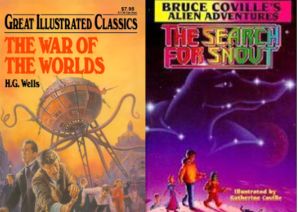
I believe the first science fiction I ever encountered would have been through the Great Illustrated Classics series, in their editions of The War of the Worlds, The Time Machine, and 20,000 Leagues Under the Sea. I can vividly remember the illustrations on these — the slight beauty of Weena, the horror of the Morlocks, the fire and darkness that marked scenes of both War of the Worlds and Time Machine. I don’t know that I conceived of these as ‘science fiction’, or anything at all — they were just stories to me, and most interesting in the drama they depicted. Imagine going on an adventure under the sea, viewing strange creatures from a large viewing point — or witnessing society being destroyed by strange alien machines from space! I was utterly gripped by them. How they shaped me as a person, I can’t say: did The Time Machine make me begin thinking of how society itself changed from age to age, and not just the technology it employed? Perhaps it planted the seed, I can’t say. I remember reading its depiction of the dying Sun with dread, not wanting to think such a thing could ever happen.
I encountered Star Trek in 1992, watching episodes of the original series from a hospital bed, and would feed my interest in it by reading Treklit from the library or with my allowance. There was a juvenile TNG series in which we follow the main characters when they were at the Academy which I remember fondly, and when I encountered Bruce Coville’s space-adventure books I knew they were like Star Trek, in that they featured a crew of aliens from different planets working together. One of the books was even called The Search for Snout, which I recognized later on as a Search for Spock reference. Goosebumps wandered into SF territory from time to time (there was at least one book set on another planet), but was largely horror.
Science fiction continued as a thread in my reading life as I aged, though I only remember two series prominently: Animorphs and Roswell High. The first features a group of middle schoolers having to form a resistance cell when a dying alien tells them that their planet is being invaded, and gives them a gift — the ability to transform into any animal they’ve touched — to fight back. Although this sounds like a simple action-adventure series, it grew dramatically and emotionally troubling as the series developed, as the kids became battle-hardened warriors who struggled with the moral choices they had to make. Especially complicating matters was the fact that the invading aliens were mind-control slugs, and their hosts — who were being killed in battles — were usually moral innocents. The Hork-Bajiir, who looked like they’d been bred for war, in truth were a peaceful species of tree-dwellers who used their many blades to obtain nourishment. It was harder to kill them knowing that, and harder still to kill humans who the kids knew were captives of the very creatures that had drawn fire to them.
Roswell High didn’t go into moral ambiguities, but had an interesting story and aliens with unique talents. I’ve commented on it separately. Likewise for the Star Trek literature I was reading at this point, which was usually Deep Space Nine novels I found at Walmart. I believe the only ‘real’ SF I read in this point was Isaac Asimov’s Positronic Man, which I found in my library and read thinking it was the novel version of The Bicentennial Man, which remains one of my favorite films. Still, at this point, I wasn’t reading science fiction for the “science” part of it — for any serious reason. I thought the possibility of aliens and robots was interesting and liked to read stories about them. I did watch a few SF films in these days, beyond Star Trek and Star Wars: what I remember most is Millennium, an interesting movie about humans from doomed airliners being snatched off them and sent to the future to help repopulate humanity after some cataclysm. It was also a light part of my PC gaming, though only through Star Trek and Star Wars related titles.
When did science fiction become science fiction to me — that is, when did I start reading it for the speculation it dwelt in, the questions it raised, the themes it played with? Honestly, I think it began in my early-mid twenties, when I’d devoured so much Asimov, including his writing about science fiction, that I began identifying more with the genre. It helped enormously, of course, that I was starting to seriously think about the world and the future at that point, and SF was a way to do that. That purposeful relationship with SF has marked my reading of it more and more, so that while I’m reading for entertainment, entertainment alone doesn’t quite suffice, though it goes a long way. Likewise, while I frequently pick up books because of the technological premise (Daniel Suarez‘ work, especially), the sweet spot for SF is when it addresses seriously the human condition. What kind of world is being made, what kind of humans? What would it mean if algorithms ran our entire lives, or if stable order was forged by removing from human life all that gave it meaning? This is probably why I’m frequently drawn to near-future titles, and especially cyberpunk which looks at the collision between man and machine, or man and corporations, head on.
What’s your story with SF?

 Reading Freely
I share your lifelong love of science fiction. My journey began in my teen years when I devoured many of the classic SF paperbacks. Since college my SF reading has diminished, but it has continued to be part of my overall recreational reading.
As you know, it all started for me when a friend of my brother tossed a copy of ‘Triplanetary’ by E E ‘Doc’ Smith into my lap with the immortal words: “You might like this…” I was then lucky to find myself reading the all-time SF classics aided by a Maths teacher @ school who lent me quite a few really good books to start me off.
After that start I essentially read *everything* SF that I could. The rest is History (and Crime).
That’s kind of how I got into reading Mafia books — one of my professors had an office FULL of titles, and when I mentioned I had just watched Goodfellas, he lent me Joseph Bonanno’s “Man of Honor”.
It’s wonderful when a genre just “grows” with you, isn’t it? Science fiction truly has that kind variety where it can pull you in at any time and in various directions!
My love of SF may not be strongly evident—mainly, I think, because I enjoy its intersections with other genres the most, and that is how I encounter it… at intervals. My favorite movie of all time is Disney’s 20,000 Leagues Under the Sea; it is a story of adventures and monsters, but also a story of injustice and the human condition, almost Dostoyevskian that way. Along with a lengthy Jules Verne phase, I explored the major novels of HG Wells, whose plots deftly incorporate the detective and horror genres. Star Trek was a bonding experience for me and my siblings and taught us something about the Cold War. Other favorite movies include Europa Report, which deals in isolation and cosmic horror, and Dune, which carries a political thriller in its midst.
This leads to the question—why science fiction? Why not other genres? I guess for me, the joy and adventure of science fiction can hardly be matched. There is also a semi-mystical quality to many of the stories that inevitably leads me to thinking about God. It’s like what you said about science fiction as a way to think seriously about the world.
It’s wonderful when a genre just “grows” with you, isn’t it? Science fiction truly has that kind variety where it can pull you in at any time and in various directions!
My love of SF may not be strongly evident—mainly, I think, because I enjoy its intersections with other genres the most, and that is how I encounter it… at intervals. My favorite movie of all time is Disney’s 20,000 Leagues Under the Sea; it is a story of adventures and monsters, but also a story of injustice and the human condition, almost Dostoyevskian that way. Along with a lengthy Jules Verne phase, I explored the major novels of HG Wells, whose plots deftly incorporate the detective and horror genres. Star Trek was a bonding experience for me and my siblings and taught us something about the Cold War. Other favorite movies include Europa Report, which deals in isolation and cosmic horror, and Dune, which carries a political thriller in its midst.
This leads to the question—why science fiction? Why not other genres? I guess for me, the joy and adventure of science fiction can hardly be matched. There is also a semi-mystical quality to many of the stories that inevitably leads me to thinking about God. It’s like what you said about science fiction as a way to think seriously about the world.
P.S. I think I just left duplicate comments, sorry about that and feel free to delete one!! WordPress is acting odd today.
Were you the “someone” who did the comment starting with “It’s wonderful”? I’ve been seeing a lot of WordPress user validation weirdness lately.
Ah yeah that was me!! I forgot to hit the login button first..
Pingback: SciFi Prompt #2: Astronavigation | Reading Freely
Pingback: WWW Wednesday + Get to Know the SciFi Reader Tag + Mystery Prompt + SciFi Prompt #13 | Reading Freely