
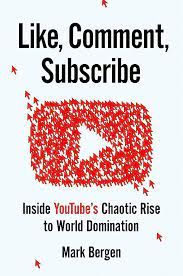
Do you remember the first YouTube video you watched? Mine was a fifteen-second clip of a guy doing a skateboarding trick, embedded in a blog post. The men who initially coded YouTube used Flash, which allowed videos to be played from other websites, giving the new website a critical advantage against other websites also exploring the possibilities of video hosting. Like, Comment, and Subscribe is a history of YouTube’s first fifteen years, one that focuses on business, with society and culture present but distinctly in the backseat. Because Google acquired YouTube so early in its life, the tension between the two marks most of the book, YouTube playing the creative young punk and Google the responsible adult who has to pay bills and fend off lawyers. I found it largely fascinating reading, from the early revelation that one founder saw YouTube as a possible dating website, to the perennial struggles of content moderation — both the question of what should be moderated, and how that should be accomplished. The book focuses more on business and technology as it goes, possibly because the torrent of content grew too voluminous to say anything meaningful about; this and the author’s predictable and unimaginative takes on The Issues of the Day progressively dampened the fun.
The beginning of the book is especially interesting: I was coming of age just as YouTube started, so a visit to its early years is saturated with nostalgia, for that time in tech in general and for the state of the website at that time. I remember using it in college to watch comedians and movies, but also enjoying the growing world of ‘original content’. YouTube began with a team that actively combed the website looking for fun videos to feature, long before The Algorithms became our lords and masters. Although the YouTube people were concerned about copyright issues from the start — concerned about the fire they’d draw, not so much keeping more pennies from piling up in Warner Bros or Disney’s pockets — not until they were purchased by Google (which had actual money to seize in a verdict) did any legal issues really surface. What would have happened to YouTube on its own is a story for some alternate timeline, but in ours Google was able to create a system to automatically identify music and video offenses, and would triumph in a lawsuit levied by Viacom. Although the website’s original creators viewed it as a creative exercise in democracy — all the content would be created by ordinary people for ordinary people — Google needed all those servers and bandwidth to pay for itself, and as the years passed things changed, especially after its own version of Moneyball came into play. Video clicks didn’t matter: what mattered was watchtime, because videos that kept eyeballs on them increased ad revenue, and changes were made that crippled the approach of many creators who posted shorter videos. Whereas ten minutes had been the maximum upload, it now became the minimum to get into profitable ad brackets. Over time, Google would face so many issues with advertisers complaining about the videos their ads were appended to that it began restricting the videos that could be monetized. Another common theme of the book is content moderation, as Google uses both human and AI to remove pornography, calls to violence, etc. This has posed constant difficulties, both technical and policy-wise. How does one differentiate fictional violence from real violence, for instance, especially when the automatic system can’t even tell the difference between Call of Duty and actual war footage? Policy wise, there were other issues: a filmed event might be offensive and inflammatory (bin Laden calling for war, for instance), but wasn’t there a case to be made for preserving events that shaped history? Google likes to shield itself with The Algorithms as much as possible, asserting that it doesn’t go around personally meddling in affairs: it simply puts its systems to work observing and enforcing the rules. Of course, those rules were written by its people to begin with.
I largely enjoyed Like, Comment, and Subscribe, although the author’s political fixations make the book almost amusing partisan at times. Need to talk about the filter effect and radicalization? Of course it’s the Other Side’s problem. We read of birthers but not truthers, of conservative anti-government types but never antifa or the mobs literally burning down cities, that kind of thing. Bergen makes no attempt whatsoever to go beyond strawmen, making him guilty of the very thing he’s pontificating about, as well as less credible as an author. Fortunately for him, the subject is interesting in itself — the under the hood look at how YouTube operates, and the rise and fall of various YouTube personalities. I’m amused by how many Youtube obsessions I was or remain oblivious to: I never heard of Pewdiepie before a year or so ago, for instance, and I would be happily unaware of ‘mukbang’ if I didn’t work at a public library where I actually see people watching it. Like, Share, and Subscribe is a generally enjoyable book, especially for those like myself who have a love/hate relationship with Google. There’s a reason I write on WordPress and not blogger these days…
Wong, a seasoned attorney who rarely got frazzled, read the email from Thailand’s Ministry of Information in late 2006 and assumed it was a fake. It came, strangely, from a Yahoo email address. But Wong quickly confirmed its authenticity and read it again: Thailand had listed twenty YouTube videos that insulted its king, a criminal offense under the nation’s lèse-majesté law.
Tim Wu, a Columbia law professor, offered a different formulation on Google’s rising power as primary gatekeeper and moderator of speech around the world. “To love Google, you have to be a little bit of a monarchist,” he told the newspaper. “You have to have faith in the way people traditionally felt about the king.”
Like other Google brass, he didn’t excel in the softer skills. Once, before a call with a prominent business partner, Kamangar asked a deputy, “What’s the emotion I need to convey?
How had Google dodged political fire? For one, the company spent $17 million in 2017 lobbying Washington, D.C., more than any other corporation. A Googler offered another explanation by way of an old joke about two hikers encountering a bear: One of them starts sprinting, while the other bends down to tighten his laces. What gives? asks the sprinter. I don’t need to outrun the bear, the shoe tier explains. I only have to outrun you. Mercifully for Google, its hiking companion, Facebook, was spectacularly clumsy.

 Reading Freely
I *really* like YouTube. I’ve learned a lot, laughed a lot, seen some amazing things…. Like everything around 90% of it is rubbish, but I’ve discovered some very good people – from a host of areas – that I keep going back to. I think my world, if not *the* world, would be a lot duller without it.
As do I! I wouldn’t say 90% is rubbish, but I don’t know how anyone outside of YouTube could assay its contents. Arguably even they can’t, because footage is constantly being uploaded. Most of the time my main page is filled with music….there are numerous channels I watch for content, but they don’t post more often than once a week/month etc.
With me it’s mostly History stuff (as you might guess!), gaming stuff, culture, book/movie things and some very funny stand-up comedians (showing that post-Woke humour is *far* from dead) [grin].
Have you encountered Ryan George? He has a series called Pitch Meetings, but also his own independent stuff that’s a little real..he plays all the characters to comedic effect.
Yes, I’ve encountered Ryan George. He’s VERY funny & all too often *spot* on in his assessments! [grin]
One of my coworkers is also a fan, so our fellow coworkers get treated to weird “Whoops / WHOOPSIE!” outbursts from time to time. Also the obligatory “Wow wow wow wow. Wow.”
Ahhh he’s great… he’s also saved me a lot of time and money with his entertaining movie summaries!
I can thank him for keeping me somewhat literate as to the plots of contemporary movies. I used to rely on CinemaSins for that, but they got obnoxous and I stopped watching them YEARS ago.