
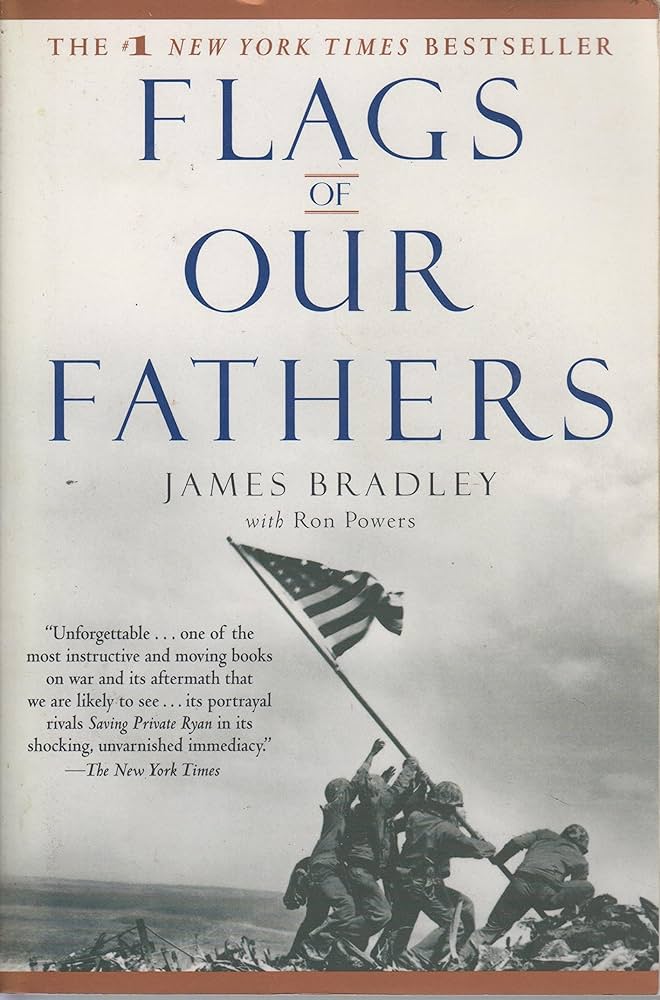
More Marines were killed in the first four days of the Battle of Iwo Jima than perished in Guadacanal over the course of five months, and the battle accounts for over a third of Marine casualties sustained in the entire Pacific War. The horror of those days cannot be readily imagined by anyone who was not there, and neither photos of Iwo then or now give a clear idea to the landscape of death that waited for the Marines who landed. James Bradley’s father was one of those men who landed and survived — a Navy corpsman, who had a part in the war’s most famous photograph, who nonetheless spoke nothing of the war to his family after his return. Flags of our Fathers is his son’s attempt to understand the journey that brought “Doc” Bradley and those five other men to Iwo, and the hell they endured there. It is eye-opening, both as an exposure of the ravages of the battle, and delving into the origin of the war’s most iconic image.
I was aware of the broad outlines of Iwo Jima — the island’s shape, its seizure ‘s strategic importance to a planned-for assault on the Japanese mainland, and to a smaller degree the death toll — but Bradley’s account draws on letters and interviews to confront the horror more directly. It’s not as graphic as a direct combatant memoir (With the Old Breed come to mind), but it’s sufficient to shock an unprepared reader. The book focuses on the men themselves, five Marines and one Navy corpsman. The most interesting me was Ira Hayes, the leftmost man in the photo who is reaching for the large flagpole but not quite reaching it: he was a Pima native from Arizona known for his reticence, and the first native American paratrooper. Tragically, although he survived the battle physically, he suffered enormously from mental and emotional trauma, and died early. Although I knew the flag in the famous photo was the second flag erected stop Mount Suribachi, I’d never read the story of the first, smaller flag. Incredibly, despite the bloodshed of the first four days, despite the fact that most of the island was still held by the Japanese, a small patrol was able to ascend the mountain and plant the flag without incident. Admittedly, they did preemptively chuck grenades into every cave or opening they encountered on the way up, but Marines who later encamped on top of the mountain could hear Japanese forces underneath them, committing suicide. They would later find hundreds of bodies. An officer requested that the first flag be replaced by a larger one so that everyone on the island could see that the high ground had been taken, and several photographers tagged along and captured not only The Photo, but video as well — and the video makes it clear how staggeringly lucky Rosenthal was to get that shot: it was a split-second fluke. If this was conveyed to the newspapermen, they didn’t pay the least attention — instead, creating a dramatic story in which American forces fought their way up the mountain, dodging Japanese grenades and raising the flag amid a storm of fire and banzai screams. The photograph was conveyed over radiophone to the States, where it immediately went the 1940s version of “viral” — making the top of the fold everywhere, and seized on immediately as an iconic of American heroism. The flagraisers who made it off the island (only half) were tapped as national heroes, to their bewilderment. It was seen as a moment of triumph even though mot of the island was still controlled by the Japanese, and that many, many deaths were yet to come…including three of the men in that photo.
Related:
With the Old Breed at Peleliu and Okinawa, Gene Sledge
Marine Combat Correspondent, Sam Stavisky
Goodbye, Darkness: A Memoir of the Pacific, William Manchester. Read this 20+ years ago in middle school, going to re-read it before the year’s end. I remember parts of the book and it’s unlike anything I’ve read since.

 Reading Freely
This is one of my favorite WW2 books.
With the Old Breed is also a favorite. I learned about that book through the series, The Pacific that was on HBO.
Thank you for the great review!
I want to watch The Pacific, but I need to finish Band of Brothers first. Have you seen it?
Yes.
My dad was a WW2 veteran. He was a veteran of the D-Day landing at Omaha Beach. And the Battle of the Bulge. WW2 books are a big genre that I read.
Pingback: September 2023 in Review | Reading Freely