

320 pages
Out of Orbit proved, despite the small scope of its subject, to be a most interesting and wide-ranging little history. When Columbia disintegrated in the skies above Texas and Louisiana in February 2003, it not only took with it seven lives, but left three men aboard the International Space Station in a heck of a fix. With the shuttle fleet grounded, how were they going to get home? …well, Soyuz. There’s literally a Soyuz parked to the station. This isn’t rocket science, guys. Er — this isn’t brain surgery, guys. Of course, it’s not quite that simple, and the book isn’t that short. It’s actually an ideal book for someone who has little to no knowledge or active interest in the space program, but who finds the thought of three men marooned in orbit sufficiently interesting to start reading — and then get the bug. Rather like Jim Lovell did with Lost Moon, Chris Jones works in partial looks back at the space program from both sides of the Iron Curtain to take us to the creation of the International Space Station, and the hopes of establishing a continuing human presence aboard it. This means not only visiting Apollo, but Skylab and Mir, as well. The result is a little history that begins with human interest hook, and then gets ya all excited and admiring about space exploration, using absorbing, descriptive writing that often puts the reader into the visor and boots of an astronaut facing a crisis far more quickly than the men and women themselves could. It’s good that Jones is able to do this, because the mission itself wasn’t terribly prolonged: another two months were tacked on, but considering that Expedition 6 had planned for a multi-month stay anyway, it’s not exactly the Shackleton expedition. More groceries from the Russians, a little belt-tightening, and bob’s your uncle. The main hitch is that the parked Soyuz available had never made a descent before, and that even if another crew were delivered to relieve Expedition 6, Russia’s Progress capsules weren’t enough to keep a crew supplied: shuttles might have been dismissed as trucks, but like their eighteen-wheeled counterparts on the ground, it was the shuttles that delivered the goods.
A coupla quotes:
Now, should something go wrong—a snapped tether, a hand or a foot restraint breaking free of the hull, the hatch door locking shut—there were only so many outcomes. Now, in all of that wide-open space, your range of possibility was terrifyingly narrow. It would begin, like all knowing deaths, with panic. Probably not a screaming, thrashing panic, because your years of training wouldn’t let you accelerate the process like that—and because you wouldn’t want the voices on the radio to sense the tremors in yours—but there would be panic nonetheless. Your heart rate would rise. Your breathing, as much as you tried to keep it slow and even, would pick up, become shallower. Despite the cold water still running through your long underwear, sweat would start coming out of your forehead, but without gravity it wouldn’t fall. If any drops were somehow shaken loose, they would float around inside your helmet, like the flakes inside a snow globe, until they had gathered enough steam to splash into your visor or bounce back into your face. That’s when you would taste the salt, when you would lick your lips and begin whispering to yourself, looking for angles, for oversights, hanging on to the last living moments of your reason, trying to find a way home.
In addition to its square footage, their home also boasted a gas fireplace, which, because it’s usually plenty hot in Houston, had found a place in the memory banks of each of the families who had seen it. It seemed to most of them like a loopy extravagance. It also had fake logs stuffed into it, which Don couldn’t abide: if he was going to watch something burn, he might as well watch something interesting burn. And so he set about replacing the logs with a diorama of a miniature village, complete with scorched rooftops and panicked residents jumping out of their windows. Whenever he flicked on the gas, the town would appear to go up in smoke—and so, too, did another wisp of his reputation each time a joyless visitor asked to see his latest creation.
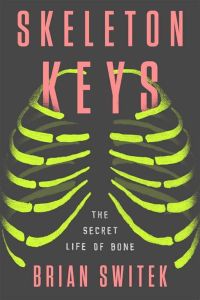
288 pages
Next up is Brian Switek’s Skeleton Keys: The Secret Life of Bone. I’d originally intended for this to be an October science read (…last year…), along with Nine Pints, but it lingered like its subject, entombed within the murky depths of Mount Doom. Switek is a science blogger and paleontology buff who is usually interested in fossils and dino bones, but here turns his attention to humans. The book begins with a look at bones’ first appearance in the fossil record (chiefly, what would become the spinal column and jaws) before moving onto more underappreciated aspects of them, like their partial plasticity: our bodies can create bones where bones don’t need to be, like from our larynx tissue, and many human cultures have deformed their skeletons, particularly skulls. Although science content is definitely present in Skeleton Keys, Switek leans hard into cultural matters — which, unfortunately, drives the book into politics several times, the most obnoxious of which is when Switek spends several pages trying to insert gender identity ideology into archaeology, and then always tacking on “osteological” to every instance of male & female to attempt to snow the reader into thinking that the current wave of mental problems and hormone chaos (largely limited to middle-class whites) has been part of natural human history alllllllllllllllllllllllllllllllll along. Paging postmodern fauxosophy, your balderdash is leaking into the hard sciences. Switek is remarkably blind to this considering how often archaeology and related sciences’ misappropriation by other political motives (racism, for instance) comes up in the book. Enjoyable enough, but disappointing. The main thing I took away from it is that Richard III had an impressively brutal death.

 Reading Freely
Pingback: Science Survey ’23 | Reading Freely
Pingback: Space Camp Readings | Reading Freely