
First in Line: Presidents, Vice Presidents, and the Pursuit of Power
© 2018 Kate Anderson Brower
327 pages
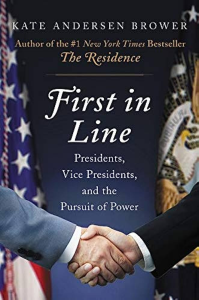
The office of vice president was, for most of the 19th century, a near-superfluous one — but in the mid-20th century, the men holding that office rapidly grew in relevance, both because of a growing habit of becoming president (through assassinations, resignation, or electoral succession) and because the ever-growing demands of the presidential office made it necessary for the president to have a working partner, not just someone to balance the electoral ticket and hang around if he should happen to die. First in Line examines the office and the men who have filled it in the last half-century, paying special attention to how the relationship between el presidente and his second have changed from president to president, and how men of ambition have coped with suddenly being reduced to the ‘guy in back’. Although many of the men profiled here are well known to the reader because they later succeeded to the office, others and their relationships with their bosses were surprises.
Harry Truman had been vice president for all of four months when he suddenly inherited one of the world’s hardest jobs, and learned (to his astonishment) of the things previously hidden from him, like the atom bomb. Vice presidents were ticket-fillers, non-entities: their only duty was to break ties in the Senate, and were otherwise barred from even speaking there. Occasionally one was called on to fulfill the primary duty of the office, assuming the presidency in the event of a death, but mostly they hung around like a bad cold and complained about the uselessness of their job. The vice presidency was where political dreams went to die. As DC’s self-appointed mission as Leader of the Free World expanded after World War 2, though, the executive branch swelled, and the potential for actively using the vice president grew with it. Despite this, presidents were slow to adapt: JFK and LBJ regarded one another contemptuously, conferring together only an hour or so a week at most, and LBJ echoed that treatment with his own vice president: he and Nixon both persisted in using the man to stand in for them at funerals and the like, but otherwise expected them to keep their mouths shut and stay out of the way. Carter was the first to see the potential for a working partnership, and effectively transformed the office, establishing a pattern for a more productive vice presidential job that steadily grew until the election of Trump, in which his vice president suddenly reverted to The Guy in Back. (For comparison: LBJ and JFK had an hour or so together alone a week: Biden and Obama had at least five, and Pence maybe talked to Trump on the phone.)
Although Bowers writes that a common trend among presidential-vice presidential relationships is that they deteriorate, her book doesn’t especially bear this out. Kennedy and Johnson never liked one another to begin with, and Nixon and Angew’s relationship was very short-lived. Carter & Mondale remained working partners, as did Reagan and Bush: the latter’s lack of a close personal friendship owed in part to the frostiness between their wives. Clinton & Gore were very buddy-buddy until Clinton’s whoremongering scandalized Gore’s wife, and Clinton’s outright lying to Gore about the affair severed the men’s own bond. If Bush wasn’t close to Cheney beyond their working relationship, who could blame him? No one wants birdshot in the face. Obama and Biden are an outright rejection of that ‘trend’, growing closer with every year, and especially after Biden’s son (Beau, not the degenerate Hunter) died. Bowers offers no shortage of surprises here: the fact that Reagan strongly wanted Ford to run as his vice president, with the men sharing some presidential responsibilities; that John Kerry wanted to tap John McCain as his second in 2004, a mixed-ticket novelty; and that Pence frequently reached out to Biden despite his boss’s overt antagonism toward Obama’s former veep. I was wholly unfamiliar with Pence before reading this, beyond viewing him as being included on the ticket to be the staid normie and win over the parts of the Republican base that viewed Trump as unpredictable at best and repellent at worse. He has a very healthy relationship with his wife, and (astonishingly) used to have a radio show. In addition to exploring relationship dynamics in full, Bowers also touches on other parts of the vice presidency, like the official residence of the old Naval Observatory house, which is universally regarded by vice presidents who have succeeded to the White House as a more comfortable residence, given its arcadian setting and fact that it’s not a museum open for public tours.
First in Line was a fun surprise for me: I don’t know that I would have read it had I not gotten into a sudden unexpected bug for presidential books, but I’m glad I took it on. Not only did it introduce me properly to some overshadowed figures in American history, but it increased my appreciation for men who could put egos aside to serve the common good. It’s also generally entertaining – -who knew Dick Cheney had a sense of humor?
Highlights:
Johnson made it clear that he considered Kennedy an entitled elitist who was too young and too inexperienced for the job. “Have you heard the news?” he asked a congressman. “Jack’s pediatricians have just given him a clean bill of health!”
In 2004, Democrat John Kerry’s first choice for his running mate was Republican senator John McCain of Arizona. The two knew each other from Vietnam and from their years in the Senate. “It was clear that it wouldn’t fly. McCain didn’t want to do it, it was clear that it would have been too controversial in other quarters,” according to a person familiar with Kerry’s decision-making. “But if you said where was his heart when this was moving along, I would say McCain.”
I’m forty-three years old,” John F. Kennedy told his aide Ken O’Donnell, to calm his nerves after Kennedy named Lyndon Johnson as his running mate, “and I’m the healthiest candidate for president in the United States. You’ve traveled with me enough to know that I’m not going to die in office. So the vice presidency doesn’t mean anything.”
The Carters’ eight-year-old daughter, Amy, cried over her father’s decision not to name Glenn as his running mate. “I wanted an astronaut to be the Vice President,” she said.
As vice president, Cheney rather enjoyed his image as one of the most polarizing figures in recent American history. Cheney’s former chief policy adviser Neil Patel said that, during the second term, he bought Cheney a Darth Vader costume complete with the iconic mask, and he wore it into the Oval Office one day and posed for a picture with aides. After leaving the White House, Cheney drove a black pickup truck with a Darth Vader hitch cover.
Cheney’s dark image was a mutually beneficial part of their dynamic: Bush did not mind being underestimated.
Biden’s uncle Ed stuttered, too, but was never able to conquer it. He never married, never got a good job, and he drank a lot. Biden never wanted to end up like Uncle Ed, so he never had a drink and he never stopped working to get over his stutter, memorizing poems and practicing speeches endlessly.
Pence declared, “Servant leadership, not selfish ambition, must be the animating force of the career that lies before you.” He continued: “Don’t fear criticism. Have the humility to listen to it. Learn from it. And most importantly, push through it. Persistence is the key.”

 Reading Freely
You definitely do have the Presidential bug ATM!
It’s Mount TBR’s fault. If I hadn’t read “The Presidents Club”, this week would have been space books (for next week, gonna have to focus this weekend) and a book on the Mississippi…
Huh! Good discovery of books on the presidency.
The Residence was a decent read, I will have to give this one a try.
This sounds like quite an interesting book. It has been a long time since I read any books about Presidential political history. One that I remember fondly is They Also Ran, about the men that did not win their respective Presidential elections. There were a few of them that very likely would have made better Presidents than the man who won. That’s one of the features of our Constitutional Republic.