
The Residence: Inside the Private World of the White House
© 2016 Kate Anderson Brower
336 pages
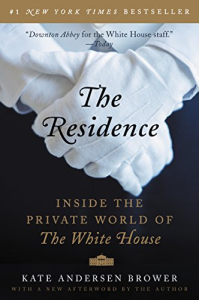
They say that no man is a hero to his valet, but perhaps no man is properly a villain, either. Richard Nixon, despised by the nation after the Watergate scandal, left a score of saddened butlers, florists, ushers, and the like after he resigned from the presidency. Perhaps the pundits and talking heads thought him a crook and a scoundrel, but to the men and women who keep the White House running, he was a kind, if formal. boss. The Residence takes us inside the White House, into the life of the home itself, where staffers continually attend to the need of the president, his family, and guests — preparing meals, arranging flowers, dusting chandeliers, buzzing about like a host of Jeeveses and providing such an array of services that outgoing presidents are left wondering if they can cope as adults anymore after so many years of having everything done for them. Although the White House staff are remarkably discreet, a few interviewed here do reveal interesting details about their former bosses decades after the facts, and Ms. Brower’s collected accounts offers different perspectives on the executives of the last century — humanizing villains, exposing the warts of heroes, and confirming that LBJ remains the most obnoxious man to ever sit in the chair.
A tourist to the White House standing on one of its lawns may regard it as a three-story structure, but it has six floors and two hidden mezzanine levels. It is a massive building, for years the nation’s largest residence and one requiring a staff of over a hundred to keep running smoothly. “Required” is perhaps not quite the right word, considering that some of the services offered by staff are over-the-top, bordering on ridiculous. Flowers in rooms are continually replaced even if no one is using the rooms; beds are changed after any use, even a 20-minute catnap; suit jackets disappear the second they’re taken off, whisked away to the dry cleaner. Was the president just taking it off to get comfortable for a few minutes? Doesn’t matter, he can wear another suit. There are even multiple chefs, one dedicated solely to pastries. Given that the White House has to entertain other muckety-mucks, all of whom are similarly indulgent, this is understandable to a certain degree. At least the president’s family has to pay for that food — a fact that apparently catches many by surprise. Although many services are provided at no charge, the executive is financially responsible for moving costs, food, and dry-cleaning — leading some presidents like Carter to plead with their chefs to be more economical, serving leftovers. (Chefs comply, to a degree, but if guests are involved not so much: the honor of the Residence demands only the best.) Perhaps that explains Trump’s serving of McDonalds! The workloads of some of the staff are absolutely nuts, with eighty-hour weeks not uncommon: one butler kept putting off getting a bypass because The President Needed Him, and died of a heart attack while on the job. There is such pride and prestige associated with working for the White House, though, that staff serve there for decades despite the stress and fact that many of them could earn more in the private sector. The election of Barack Obama made black staffmembers (who appear to be in the overwhelming majority, judging by the included photos) especially proud to serve.
Ms. Brower’s book addresses a variety of aspects about interactions between its staff, the president, and his family. We get to know the executives and their wives as bosses, not national leaders, and some of them were pills to work for. Jackie Kennedy & Nancy Reagan were especially demanding, though Mrs. Reagan’s husband was far easier to get along with. President Reagan was downright chummy with the staff, so eager to get in long conversations that those with a job they needed to get done in a hurry might politely avoid him just so they could get about their business. The worst boss award has to go to LBJ, who was not only a constant abusive bully, using his height and other anatomical bits to intimidate staffers (and guests), but had a bizarre obsession with the shower, which he used over $10,000 worth of military funds to alter to his demands — creating a unit that sprayed with more force than a firehose, at scalding temperatures, with separate nozzles pointed at various parts of his under-the-belt anatomy. Working in the White House has the odd quirk of the job potentially radically changing every four years: no sooner has one family’s dining tastes and personality quirks been learned and absorbed than comes a new set of bosses, with wildly different attitudes and needs. The Kennedys and Clintons favored fine dining and haute cuisine: Johnson and Bush preferred simple Texan fare like chili and Tex-Mex. (Well, Hillary preferred haute cuisine: Bill snuck junk food whenever he could get away with it.) Going by this account, George H.W. Bush and his wife were by far the most generally popular — loved, even, and so mourned by the staff at their departure that Hillary axed one of them on suspicion that they were calling Barbara to leak information about the Clintons. (In reality, Mrs. Bush was calling one of her staffers-turned-friends for help using her new computer.) The elder Bushes hit the sweet spot of respect and conviviality — not too familiar, not too formal, and they and their son established such friendships with staff that even after retirement, George W. sometimes went fishing with old favorites. Speaking of kids, Brower has a separate chapter on growing up in the White House, which is easier for small kids who know nothing else (like the young Kennedy) and much harder for those like the Bush girls who have experienced some degree of normality. (As ‘normal’ as you can get when granddad was president and dad was governor & owner of an MLB team, anyway.)
This was an all-around fun book to read, offering surprises and confirmations at the same time. I’d heard JFK was a womanizer, for instance, but didn’t realize that he had such a reputation for womanizing and adultery that the staff learned to avoid the second floor altogether in Jackie’s absences, given the high chances of seeing naked secretaries dashing around. (Also off limits: the pool, where he could be found sitting naked with similarly clad lasses.) I was surprised that Nixon was so much more well regarded by the household staff than the West Wing staff, though I’ve never really delved into his presidency beyond his economic mischief and foreign policy. Ms. Brower confirms an odd allegation I’d encountered about Eleanor Roosevelt, who did indeed fire all white domestic staff members and replaced them with blacks, on the grounds that staff worked better when they were all of the same ethnic group. Madame Segregation, that’s our Mrs. Roosevelt. Although reading about the extraordinary expenditures that go into White House operations made me grumble and harrumph (especially the constant redecorating at taxpayer expense) I couldn’t help but be charmed by the human image of the executive families — of Michelle Obama and Hillary Clinton doing their best to give their girls normal lives, of presidents confiding in valets during elevator rides when the burdens of the world and their family were crushing them — and enjoyed this thoroughly.
If you are tiring of this week’s spontaneous theme, I regret to inform you that it shall continue. You’ll get a reprieve when Space Camp kicks off, though.


 Reading Freely
I love your review so much that maybe I end up reading this.
Thank you! If you do, I hope you enjoy.
Pingback: The First Family Detail | Reading Freely