
The 99% Invisible City: A Field Guide to the Hidden World of Ordinary Design
© 2020 Roman Mars
400 pages
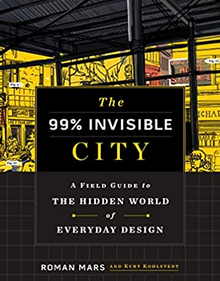
I’ve spent many hours in two of my city’s oldest buildings — one a church, the other a mixed-use Italianate beauty turned residence & bar — and have noticed, over the years, that the amount of little details contained within these beautiful structures is apparently infinite. There’s the outward big-picture stuff one notices — the loggia at the Harmony Club, the cloistered walk at St. Paul’s — but long exposures bring out other little things, like the fleur-de-lis welded onto the HC’s rain pipe, or its terazzao flooring at the landing. How staggeringly vast, then, must these little details be in an entire city? The 99% Invisible City takes as its subject mundane features that are part of the urban landscapes most of us inhabit, but often which we would not notice. This is aimed for a more general audience than something like Infrastructure: A Field Guide to the Industrial Landscape, because it looks only at little and local details.
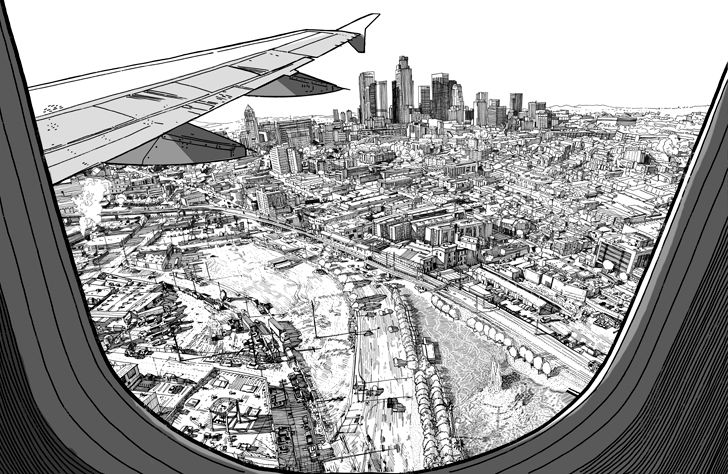
Since I’ve previously read books like Infrastructure: A Field Guide to the Industrial Landscape and The Works: Anatomy of a City, I expected to thoroughly enjoy this and was not disappointed. The book stands out from the aforementioned because of its use of art, not only to preface chapters and sections, but often to illustrate the text. The cover itself gives some indication as to the quality, but some of the interior work is far more impressive. A draftsman friend of mine did a double-take when he saw me reading the book, in part because he follows the artist Patrick Vale online.
99% Invisible does not dig into the buried infrastructure of cities like pipes and underground cables: instead, the focus is on things which are on the surface, but unnoticed by virtually everyone — except for those who remain in a given spot for a long time and have occasion to start noticing the fine details. This subject includes things like manhole cover art, which varies widely from city to city; markings on utility poles and sidewalks that enable linesmen and engineers to communicate technical details and warnings to one another in a code of their own; and components on lighting posts that enable them to pop up and then over cars when they’re struck by a vehicle driven by someone texting, drunk, or trying to pass their backseat toddler a sandwich baggie of goldfish crackers. This is not a book about infrastructure detail, though: Mars casts his eye over the city more broadly, looking at the unique boundary markers present in D.C, the history of revolving doors, and cell towers disguised as flagpoles. I was already aware of the hidden cell towers, but Mars delivers more than a few surprises — like power substations disguised as houses, and emergency subway stops/exits which empty into similarly disguised buildings.
This is one I’ll definitely recommend and pass on to friends — both for its multitude of interesting little microsubjects, and its art.

 Reading Freely

Pingback: Midyear Review & June 2023 | Reading Freely