
The Psychopath Test: A Journey Through the Madness Industry
© 2011 Jon Ronson
290 pages
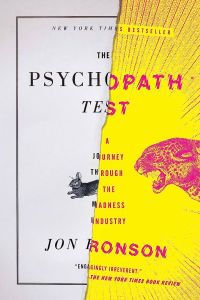
Jon Ronson’s journalistic niche is the weird, so when he learned that numerous intellectuals across the western world had received identical volumes of the same modified book — a richly bound but thin little volume that consisted of both blank pages and cryptic messages, with an identical square cut out of each volume’s page 13 — he had to find out more. The recipients found one another in their attempts to find out what on earth they’d received, and one of them reached out to Ronson to enlist his help. Ronson’s own investigation determined that the books were sent out by a particular person who he realized was a little mental, and he wondered that so much activity — including transatlantic meetings! — could result from the random activity of a crazy person. Maybe it’s not reason or love or money that makes the world go round. Maybe it’s madness. His interested kindled, Ronson then began exploring the world of being ‘crazy’: what is it? How do you know? — and then became interested in psychopathy in general after meeting someone who claimed to have faked mental illness to avoid prison, only to find himself locked up in one of Britain’s worst-case offender nuthouses.
Mental illness of varying kinds is steadily on the rise, spurred by both The Professionals’ urge to stick a label on everyone so they can sell them pills, and by the fact that 21st century American society is deeply dysfunctional, our animal brains deprived of much of what they need and saturated with so much of what they don’t. But there’s a difference between being depressed and anxious and being certifiable –– but behavior is so subject that even a normal person can get themselves in trouble, as witnessed by the Rosenhan experiment of the 1970s, in which a team of researchers faked diagnoses to get themselves institutionalized, and then learned that once a label had been appended to them, all of their behavior was interpreted to further justify and strengthen the diagnosis. This is not a problem unique to mental health, of course: as Will Storr discovered in his forays into conspiracy thinking, once people adopt a narrative our strongest tendency is to continue working anything new into the existing narrative. (For what it’s worth, the Rosenhan experiment has also been been deeply scrutinized, the publisher of the paper accused of exaggerating and cherrypicking his data.) Ronson’s time spent with someone locked up in one of Britain’s units for dangerous psychopaths intrigues him, in part because the man is utterly unlike everyone else: ‘Tony’ maintains he faked being mad using movies as his inspiration in hopes of avoiding a prison term, only to find himself stuck with an interminable sentence at a far less humane institution. The doctors maintain that Tony’s ability to fool Ronson is part of his psychopathy: he has no real emotions, but he has studied neurotypical people and can imitate and even manipulate us. Ronson is made cautious, but not convinced, especially after he goes forth to visit other people regarded as psychopaths and finds them decidedly more chilling by comparison. These include one man who was a prominent political figure in the Carribean and another who was a CEO.
The Psychpath Test is interesting and entertaining, but tends toward the disorganized.
Highlights:
“Can’t you see? It’s incredibly interesting. Aren’t you struck by how much action occurred simply because something went wrong with one man’s brain? It’s as if the rational world, your world, was a still pond and Petter’s brain was a jagged rock thrown into it, creating odd ripples everywhere.”
“Grandiose sense of self-worth?” I asked. This would have been a hard one for him to deny, standing as he was below a giant oil painting of himself.
“I think it’s rather a sad story, David,” said Belinda. “According to Messiah culture, or prophet culture, you’re making several mistakes. Firstly, you’re not taking time out to really meditate on your mission. You’re coming public far too soon. Secondly, you’re not gathering a following around you. Thirdly, you’re announcing it yourself when really it should be for other people to say, ‘He is the One,’ and start to bow down to you or whatever. But you’re coming out and throwing it at everybody. My point is, you’re not behaving in a very Messiah-like way.” David shot back that seeing as how he was the Messiah, any way he behaved should be considered a Messiah-like way.
Practically every prime-time program is populated by people who are just the right sort of mad, and I now knew what the formula was. The right sort of mad are people who are a bit madder than we fear we’re becoming, and in a recognizable way. We might be anxious but we aren’t as anxious as they are. We might be paranoid but we aren’t as paranoid as they are. We are entertained by them, and comforted that we’re not as mad as they are.
I wondered if sometimes the difference between a psychopath in Broadmoor and a psychopath on Wall Street was the luck of being born into a stable, rich family.

 Reading Freely