
That title is just a way of me combining two Civil War short rounds into one post. (Billy Yank wins the five-game series, 3 to 2, but in a show of terrible sportmanship, burned the stadium on their departure.)
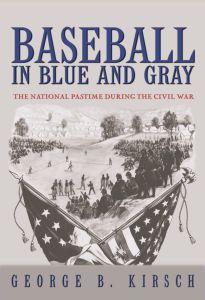
First up, Baseball in Blue and Gray: The National Pastime during the Civil War. This brief little book covers baseball in the 1860s, both at home and in military camps. Although primarily about the war years, author George Kirsch often refers to the 1850s to give better context. Baseball was not quite the sport as we know it here, but its head was definitely breaching. Kirsch offers a brief overview of the origins of baseball — the popularity of stick-and-base games in England, their migration to America and subsequent evolution of proto-baseball games with varying rules — before charting the progress of baseball through the war. The game was a popular, not professional sport back then: schools, workplaces, and fraternal organizations had their own teams of ‘nine’ that would play against one another, but no one was ‘paid’ — not officially, anyway. Despite so many men being off at war, baseball became an increasingly popular spectator sport during the conflict, possibly as people sought relief from the war news. When the Army of Northern Virginia invaded Pennsylvania in hopes of forcing a defeat on the Yankee army to end the war, Pennsylvania newspapers nontheless published article after article about Philadelphia’s team playing a series against New York squads. At this time there were still different baseball rules, but the “New York” rules that modern baseball is based on became the standard during the war years. Baseball was also a constant diversion for soldiers, both on campaign and in prison camps, and the bringing together of men from different parts of the country together helped the sport spread from the northeast and midwest where it was most popular to across the country in general. Officers supported the game, since it promoted ‘good martial virtues’, and presumably was a healthier way to keep the men entertained than drinking and gambling. Soldiers tended to use more informal rulesets than the New York approach, given the problem of supplies (especially for southerners) and the chaotic nature of war. Kirsch reports one instance of a ballgame being interrupted by an attack, in which the outfielders were shot and taken prisoner, but the infielders managed to get back to the safety of their lines. Informative but short!
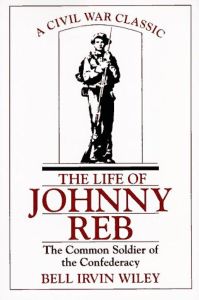
Nothing charms me more in studying history than seeing through mere text and photos and discovering the human underneath. Too often the common soldier of the Civil War, rebel or yankee, is viewed only for his part in a political story created after the fact. The humble shoulders of a working man turned soldier, whose affections are for his country, his home, and for his sense of rightness and duty, are saddled Atlas-like with notions of a great crusade in which he is either the hero or the villain. This is especially true these days, when men who fought for nothing more or less than their grandfathers fought not eighty years prior are demonized for the sins of the politicians running things, so that the current generation of politicians can score brownie points attacking the memory of men with far more integrity and honor than themselves. In such a time, it is absolutely refreshing to encounter a text like The Life of Johnny Reb, an utterly comprehensive history of the ordinary soldier, the man who fell by the hundred thousands not for politics but for matters more mundane and important, like his home. Not only does Bell Irwin Wiley draw deeply here from the letters and diaries of soldiers, but he lived in a unique and rapidly dying time when there still existed a few souls who had fought in the war, who could tell him first hand of their experiences. They could even imitate, however weakly, the ‘rebel yell’. From Wiley’s considered study we experience every aspect of a soldier’s life: his high spirits on joining up, his struggles with disease and injury and officers, his vices and diversions, his taking consolations in letters home and religion, and his endurance, adaptability, and courage despite constant want of supplies and precious little pay or respite from the front. This is one of the few Mount Doom books I plan on keeping, and I’m going to read Wiley’s Life of Billy Yank once I’ve made more headway on said pile o’ books.

 Reading Freely
Pingback: Midyear Review & June 2023 | Reading Freely
Pingback: For Cause and Comrade | Reading Freely