
© 1971 Beatrice Sparks
271 pages
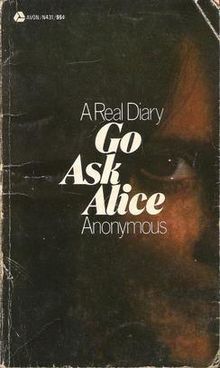
Go ask Alice / I think she’ll know / When logic and proportion have fallen sloppy dead…
Recently, while doing some cleaning to the sounds of the Vietnam War, I heard a song urging me to “Go ask Alice.” So that’s where that comes from, I thought, suddenly remembering a novel I read in my youth — read repeatedly, because it was my first glimpse into a vision of the 1960s that wasn’t romantic and idealized, but based instead on darker imaginings. Presented as a diary, and allegedly based on a real teenager’s actual experiences, it’s the story of a young woman who falls into drug abuse through the late sixties, a coming of age story where the subject grows in depravity instead of maturity — in the end, struggling with own sanity. Although it’s dismissed as a fabrication now, to a sheltered teenager like myself it did an excellent job at depicting the drug culture as a horrific thing to be avoided.
I read this novel repeatedly in high school, in part because it was my keyhole glimpse to the ‘real’ world. I knew enough to know I was sheltered, and was curious about the lives other teenagers lived — my own was wrapped up in a HP Pavilion, whose 9 gigs of hard drive space somehow held more than enough to keep me distracted for those years. Go Ask Alice is fabulous as anti-drug propaganda literature: it certainly worked on me: I suspect it’s the root of my own wariness regarding drug use many years after high school. As a story, it’s compelling enough; we witness a young woman struggling with insecurity get exposed to LSD at party. The experience makes her feel alive and sociable, in tune with the universe, and she enthusiastically explores every other substance she can get her hands on. In short order she becomes jaded and retreats from old influences to get her life back together, but finds herself stuck in a cycle of abstinence > temptation > indulgence > decadence > disgust > abstinence until ultimately….well, it’s a tragic ending. I wasn’t a teen in the sixties, and I’ve never consumed anything more interesting than single malt Scotch, so I can’t speak to the realism of this at all. It’s fascinating reading for someone who’s completely outside this world, though, and I still appreciate it for its look into the tumultuous world of the late sixties.

 Reading Freely
This worked on me, too. I was in jr. high when I read this and I was scared straight! I’d love to read this again and see what it was that worked so well. Maybe I should have my kids read it….LOL!!!
I was that age, too — I believe I received the book for Christmas ’98, when I would have been 13 or so.