
Previous yearly wrap-ups: 2007 | 2008 | 2009 | 2010 | 2011 | 2012
The year turns once more and it’s time to look back on the past’s reading, to think about which books really stood out and to reflect on the year in general. Let’s begin with pie!
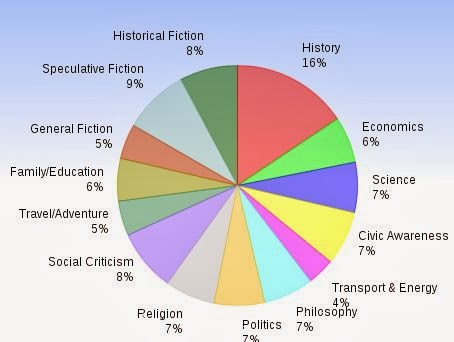
As usual, ChartGo did the data-baking, and nonfiction dominated. This year was heavy on civics and society, economic and political philosophy, and bicycles; when I drew up a ‘top twenty’ list, most of the books fell into these categories. Toward the end of the year I also got into outdoors-adventure books, including a lot of cycling memoirs.
The great theme that emerged from my reading this year was civics, society, and living humanely. Not only did I read a great many books about the material arrangement of society, like those on city planning, but I also considered thoughtful works on other aspects of society: culture, politics, economics, and more. Diverse authors who never met one another, who may have not have even heard of one another, have worked in concert inside my head to prompt a sea change therein. In trying to understand how society works, so that I might do my part to help create more resilient, healthier communities, I have developed a sharp aversion to the large-scale, top-down, and heavy-handed approaches I once favored, instead now preferring smaller, locally-oriented, and ‘organic’ tacks that emphasize healthy relationships between people, connect them to their physical place, and promote inner reliance or autonomy. And so, the best from this sweeping category, books in bold indicating membership on the Top Ten Favorites for the year.
- The Plain Reader: Essays on Making a Simple Life, edited by Scott Savage
- The Death and Life of Great American Cities, Jane Jacobs
- Walkable City: How Downtown Can Save America, Jeff Speck
- Religion for Atheists, Alain de Botton
- Folks, This Ain’t Normal: A Farmer’s Advice for Healthier Hens, Happier People, and a Better World, Joel Salatin
- Pedaling Revolution: How Cyclists are Changing American Cities, Jeff Mapes
- Straphanger: Saving Our Cities and Ourselves from the Automobile, Taras Grescoe
- The Righteous Mind: Why Good People are Divided by Politics and Religion, Jonathan Haidt
- Down the River, Edward Abbey
- The Unschooling Handbook, Mary Griffth
- What Are People For? Wendell Berry
- Home Economics, Wendell Berry
General Fiction
- Martin Eden, Jack London
- Jayber Crow, Wendell Berry
- Hannah Coulter, Wendell Berry
- The Screwtape Letters, CS Lewis
- Waiting on a Train was a superb layman’s history of passenger rail in the United States, that examines its reviving prospects in the age of high-dollar oil.
- Susan Strasser’s Never Done: A History of American Housework was a sweeping history (sorry) of American households, watching how household duties, once productive, became mere chores and avenues of consumption. Strasser is a wonderful author of social history.
- Alexander Hamilton, Rob Chernow. Hugely informative and honestly biased, this tome looks at the life of a man who rose from poverty to become George Washington’s aide and a member of the first cabinet, who had a vicious relationship with both John Adams and Thomas Jefferson.
- The Box: How the Shipping Container Made the World Smaller and the World Economy Bigger, Marc Levinson.
- The Little Ice Age: How Climate Made History, Brian Fagan
- Chimpanzee Politics by Frans de Waal
- Your Inner Fish; The Universe Within, Neil Shubin.
- Two Sides of the Moon, David Scott and Alexei Leonov
Historical Fiction
- Sharpe’s Revenge, Bernard Cornwell
- Pride and Prejudice, Jane Austen
- Field Grey, Phillip Kerr
- From History’s Shadow, Dayton Ward. Treklit and historical fiction, this history of the United States’ attempts to investigate claims of alien life begins shortly after 1947 and
- 1632, Eric Flint. What happens when you drop a Pennsylvanian mining town into the middle of 17th century Germany? Good times.
- Basic Economics, Thomas Sowell
- The Invisible Heart, Russ Roberts
- Satisfaction Guaranteed: The Making of the American Mass Market, Susan Strasser
- Salt, Sugar, Fat: How the Food Giants Hooked Us, Michael Moss
- Garbageland: on the Hidden Trail of Trash, Elizabeth Royte
- Into Thin Air, Jon Krakauer
- Hey, Mom, Can I Ride My Bike Across America? John Siegal Boettner

In the long run I think I’ll remember this year most for introducing me to one Wendell Berry, an aging gentleman-farmer from Kentucky whose ideas on the good life are expressed in both essay collections and novels. I encountered Berry first when one of his essays, “Health is Membership”, appeared in The Plain Reader, a collection of essays on the simple life, many of them rooted in the Quaker tradition. He writes reverently of the need to conserve and live a life grounded in Nature, mindful of the limits it would suggest for the scale of our activities. He champions a nation based on family farms, small towns, and decentralized political power; he writes against and mourns the destruction caused by agribusiness, urban sprawl, and big stick approaches to little problems. His essay collections are wise and often godawful funny, while the novels are painfully beautiful. I read Jayber Crow back in June, and not a day goes by that I don’t think of it– quote aloud from it, even. Wendell Berry joins the very-elite club of featured authors for me, alongside Isaac Asimov and Bernard Cornwell.

 Reading Freely
That's a *very* even spread. My chart would be nothing like that! [grin]
Indeed; 7% seemed to be a magic number. Usually I have two or three big clumps (history and religion/philosophy always ranking) and then a lot of smaller categories..
You reviewed a lot of books last year that I missed when you made the original posts — huge year for British history!
British (and mainland European) History is my passion ATM. Much more to come too – including my next review on Monday!